💡 Use full sentences with «I think…», «In my opinion…», «Personally, I…» — the same registers you need for Task 3 & 4.
2
Topic Vocabulary · 24 words across 4 epochsToolbox
Tap a card to flip · era-tag shows which epoch the word belongs to
First — read & flip — make sure you can use each word in a sentence:
Key collocations for Russia-themed speaking
to be crowned tsarto found a cityto open a window to Europeto carry out reformsto abolish serfdomto abdicate the throneto overthrow the monarchyimperial heritagefirst person in spaceto be proud of
Quick check — fill the blank (drop-down):
1. Peter the Great Saint Petersburg in 1703.
2. Nicholas II in 1917 after the February Revolution.
3. In 1861, Alexander II serfdom in Russia.
4. Yuri Gagarin became the first person in April 1961.
5. Catherine the Great is often called an example of .
6. The Winter Palace was the official of Russian emperors.
7. Ivan IV was the first Russian tsar in 1547.
8. The Great Patriotic War lasted from 1941 to 1945 and cost millions of .
9. The Russian tricolor stands for .
10. The USSR was in 1991.
3
Word Formation drill · warm-up for Tasks 25–29Toolbox
6 items · type the right form · «Show» reveals · full 25–29 sim comes later, in the Grammar section
Right form = right ending. Watch for spelling (achieve → achievement), part of speech, positive/negative prefix. Six early items to warm up your suffix-radar.
4
Listening 1 · Six young Russians talk about their hobbiesEGE 1 · Б · 2 points
6 speakers ↔ 7 statements · one statement is extra · press ▶ Play
Six teenagers · what they love to do~90 sec · Amazon Polly · full transcript below
📄 Full transcript (6 speakers · dense B2)
Speaker A: I've been dancing ballet since I was six, and this September I finally passed the entrance exam to the Moscow State Academy of Choreography — one of only twelve girls chosen out of nearly two hundred applicants. My days are now split between academic subjects in the morning and four hours of pointe work in the afternoon, and by the time I get home I can barely feel my toes. My friends outside dance think I'm a bit crazy, but on stage every muscle finally makes sense, and I honestly can't picture my future without the smell of resin and the sound of a live orchestra.
Speaker B: Every August my family disappears from the city and heads out to a small settlement on the shores of Lake Baikal. We take the overnight train from Irkutsk, then a wooden boat piled with tents and cooking pots, and we live for a fortnight without electricity or reliable mobile signal. It sounds hard, but it's the only place on earth where the silence has a physical weight — no traffic, no notifications, just the wind, the ripple of freshwater against the rocks and, at dawn, the occasional call of a nerpa seal. Those two weeks reset something inside me that Moscow can't fix.
Speaker C: Almost every Sunday I catch the metro to the Tretyakov Gallery, where my mother has worked as a guide since before I was born. Growing up between Serov's portraits and Vasnetsov's fairy-tale panels, I learned to read a canvas before I learned to read a book, and by ten I already knew which brush strokes belonged to whom. I've decided to study art history at university and, if things go well, to train as a museum curator specialising in the Russian silver age. My mother pretends she isn't influencing me, but I know she's secretly thrilled.
Speaker D: After school I devote at least three hours a day to online chess — not just casual games but proper analysis with a coach in Saint Petersburg who follows my openings via video call. My Elo rating has just crossed 1930, which is high enough to qualify me for the junior regional championship in Kazan next month, and if I place in the top three I get a place at the national training camp. People still think chess isn't a sport, but after a five-hour tournament your back aches, your eyes burn and you sleep for twelve hours straight — believe me, it counts.
Speaker E: I've supported Spartak Moscow since I was seven, when my grandfather first took me to the old stadium on a freezing October evening — I still remember the smell of grilled sausages and the roar of forty thousand voices around us. Now we go together at least once a month, and even though he can hardly climb the stairs to our seats any more, he refuses to give up his season ticket. Some of my classmates prefer basketball or online games, but for us, football is really about the two of us: three generations of Spartak scarves in one family, and a hundred stories on the way home.
Speaker F: Baking has become the thing I turn to whenever school gets too much — my grandmother taught me the family recipes when I was still standing on a stool to reach the counter. We make kulich cake for Easter with candied fruit and saffron, tall stacks of blini for Maslenitsa served with sour cream and salted red caviar, honey cake soaked overnight for birthdays, and gingerbread pryaniki for New Year's Eve. There's something almost meditative about kneading dough and watching yeast come alive, and my kitchen slowly filling with the smell of vanilla is honestly better than any therapy I could afford.
Match speaker to statement · one statement is EXTRA
A Speaker A · ballet, rehearsal studio, stage
B Speaker B · Baikal, train, camp, silence
C Speaker C · Tretyakov, guide-mother, art history
D Speaker D · chess, rating, championship
E Speaker E · Spartak, grandfather, stadium
F Speaker F · baking, grandmother, Russian recipes
Statements bank (1–7)
1. This person combines a hobby with real competitive achievement.
2. This person plans to turn a family passion into a profession.
3. This person misses their old childhood hobby.
4. This person is training hard for a career on stage.
5. This person shares their hobby with an older relative.
6. This person values silence and nature above everything.
7. This person uses their hobby to relax.
5
Listening 2 · Hermitage tour · dialogueEGE 2 · Б · 3 points
Anna and her cousin discuss a school trip to the Hermitage · T / F / Not stated · 7 statements
Anna & Denis · Hermitage school trip~75 sec · dialogue · listen once
📄 Transcript (dialogue)
Anna: Denis, guess what — my class is going to the Hermitage next Friday!
Denis: Lucky you! Is it a whole day?
Anna: Almost. We leave school at nine, and we're back around six. Our history teacher is coming with us and also our art teacher, Maria Ivanovna.
Denis: Have you booked a guide?
Anna: Yes, an English-speaking one — because we want to practise. It costs a bit more, but the school pays for the tickets.
Denis: Nice. What are you most excited about?
Anna: The Egyptian rooms. I've been to the Hermitage twice before, but always to the Winter Palace section — never to the ancient art.
Denis: I've never been at all. My parents keep saying we'll go «next summer», but next summer never comes.
Anna: Come with us! Actually no — my teacher said the group is full.
Denis: Fine. Take good photos then.
True / False / Not stated · 7 statements
1. Anna's class is going to the Hermitage next week.
2. Only one teacher is coming with Anna's class.
3. The guide will speak English.
4. The school pays for the guide.
5. Anna has never been to the Hermitage before.
6. Denis has been to the Hermitage once.
7. Denis will join Anna's class trip.
6
Listening 3 · Interview with a young Russian scientistEGE 3–9 · В · 7 points
Interview with Anna Volkova, PhD student at Skoltech, 24 · 7 MCQ · full understanding
Anna Volkova · young scientist~2 min · interview · listen once, decide, move on
📄 Transcript (interview)
Host: Anna, thanks for joining us. You are only 24, but you already lead a small research team. Tell us how it all started.
Anna: Well, I grew up in Novosibirsk, in a family of engineers. My father worked at Akademgorodok, so science was our dinner-table conversation. But interestingly, I didn't want to be a scientist. I wanted to be a doctor. I only changed my mind at seventeen after a summer school in physics.
Host: Where did you study?
Anna: I did my bachelor's at Novosibirsk State University, then moved to Moscow for the master's programme at Skoltech. Now I'm finishing my PhD there. My topic is renewable energy — specifically, small solar panels for remote Siberian villages.
Host: Have you spent time abroad?
Anna: Yes, one exchange semester in Munich, and last summer I gave a talk in Tokyo. Both trips were useful, but I always want to come home. My problem is here — Russian villages, Russian climate.
Host: What's the biggest difficulty in your work?
Anna: Money is not the main issue — Skoltech supports us well. The real problem is time. A single test run in a Siberian village takes three weeks. And weather can ruin months of preparation.
Host: Any advice for young girls who want to enter science?
Anna: Two things. First — don't listen to people who say «girls don't do physics». They're wrong. Second — start small, but start early. A school project counts. A blog counts. Show your curiosity, don't just talk about it.
Answer 7 questions
1. Anna grew up in…
2. As a child she wanted to become…
3. Her PhD topic is…
4. She spent time abroad in…
5. According to Anna, her main daily difficulty is…
6. One test run in Siberia takes about…
7. Her advice to young girls is to…
Interlude · Great Russian Voices
Five voices that shaped the century
Yuri Gagarin · 1961 · «The beauty of our planet — let us safeguard it, not destroy it»
Leo Tolstoy · 1877 · «All happy families are alike; each unhappy family is unhappy in its own way»
Fyodor Dostoevsky · 1880 · «Not just to stay alive — but to find something to live for»
Konstantin Tsiolkovsky · 1911 · «The Earth is the cradle of humanity, but not forever»
Anna Akhmatova · 1912 · «I taught myself to live simply and wisely»
7
Reading 1 · 7 iconic Russian places · match texts to titlesEGE 10 · Б · 3 points
7 dense B2 texts · 8 titles · one is EXTRA · themes: nature · engineering · power · ballet · sport · art · region · answers shuffled
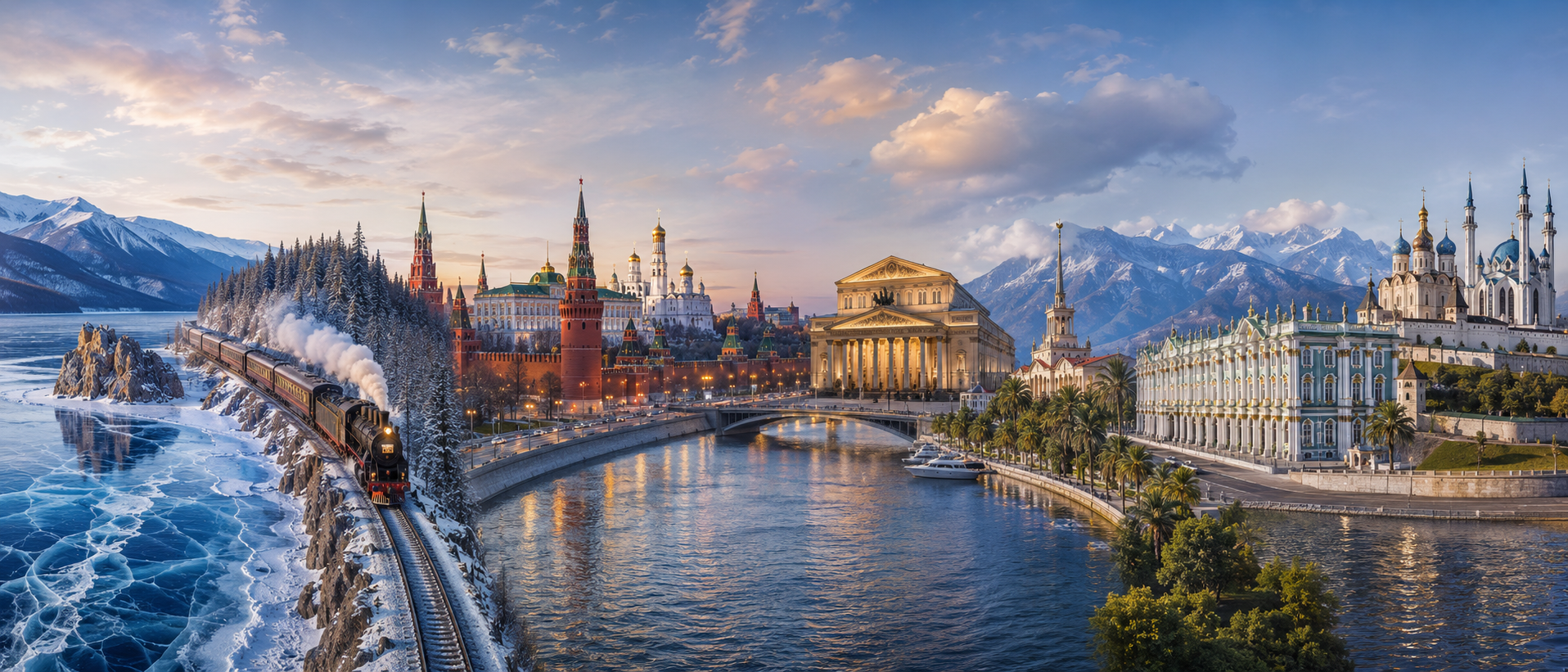
A Formed some twenty-five million years ago and set deep in the mountains of southern Siberia, this crescent-shaped body of water holds around one-fifth of all unfrozen fresh water on the planet. Local people, whose ancestors were Buryat shamans, still call it the sacred sea. It shelters an extraordinary collection of endemic species — from the transparent shrimp that filters its water to the nerpa, the only exclusively freshwater seal in the world. In late winter, when the surface freezes into ice so clear that you can watch fish swim beneath your boots, hundreds of skaters and photographers make the long trip from Irkutsk to see it.
B Stretching for nine thousand two hundred and eighty-eight kilometres — the longest continuous railway line on the planet — it was ordered by Alexander III and finished, at colossal human cost, under his son Nicholas II. Its rails cross eight time zones, seven federal districts and virtually every possible landscape, from marshy taiga north of Krasnoyarsk to the Ural passes and, finally, the port hills of Vladivostok. To this day, ordinary travellers who buy a platzkart ticket end up sharing tea and family stories with complete strangers for six or seven nights on end.
C Encircled by fortified red-brick walls that have withstood fire, invasion and revolution, this cluster of gold-domed cathedrals, senate halls and squat towers has served as the operational headquarters of Russian power for more than five hundred years. Ivan the Terrible was crowned inside its Assumption Cathedral, Napoleon watched Moscow burn from its ramparts, and the twenty-first-century presidents still walk to work through the same medieval gates. Even the enormous Tsar Bell, cast in 1735 and never rung, lies quietly beside the Ivan the Great Bell Tower, as if waiting for its cue.
D Founded in 1776 and rebuilt after a devastating fire in the reign of Alexander II, this Moscow theatre gave the world Marius Petipa's choreography, Tchaikovsky's Swan Lake and, later, the defection of Rudolf Nureyev. Behind its heavy gold curtain, a company of some two hundred dancers still trains twelve hours a day, and any ticket to an opening night — even in the highest gallery — is considered an event on its own. To grow up on this stage is to be reminded, every evening, that Russia has exported ballet as vigorously as any of its natural resources.
E A subtropical resort city where palm trees line the promenade and the Black Sea rarely falls below plus five in January, it stunned the world in 2014 by hosting the Winter Olympic Games. Downhill skiers competed in the freshly-carved slopes of Krasnaya Polyana, forty minutes up the mountain, while figure skaters performed at sea level beneath waving palms. The Games left a legacy of high-speed rail, four-star hotels and, more controversially, one of the most expensive infrastructure bills in Olympic history. Today, both Russian and international tourists come year-round — for skiing in February and swimming in July, sometimes in the same week.
F Originally the private art collection of Catherine the Great, opened up to the public only in 1852, this green-and-white palace on the Neva now houses more than three million objects — from Rembrandt's return of the prodigal son to Egyptian sarcophagi and Matisse's dance. Its Winter Palace section alone contains almost four hundred rooms, and a curious visitor could spend, on average, nine seconds at each exhibit and still need two full years to see it all. Meanwhile, some seventy cats descended from those brought in by Elizabeth Petrovna to hunt rats still officially patrol the basement corridors.
G A thousand-year-old city on the Volga where the pale-blue minarets of the Kul Sharif Mosque and the golden crosses of the Annunciation Cathedral share the same fortified skyline, and every street sign is written in two alphabets. Once the medieval capital of the Tatar Khanate, and later a proud showcase of the 2013 Summer Universiade, it is now one of the most economically dynamic cities of central Russia. Ask any local student what makes their city different, and the answer usually comes with pride: here, two civilisations don't just meet — they cook, work and pray together.
Titles bank (1–8) · one is EXTRA
1. A rail line stretched across a continent
2. Where two faiths share a skyline
3. Palm trees and ski slopes side by side
4. The deepest lake and the clearest ice
5. Rembrandt, Matisse and seventy cats
6. A theatre that trained the world's dancers
7. Five centuries at the seat of power
8. Aurora borealis over the tundra (extra)
8
Reading 2 · Russian traditions · fit the missing fragmentsEGE 11 · Б · 2 points
1 text · 6 gaps · 7 fragments in the bank · one fragment is EXTRA
Even Russians who live in big cities and rarely open a history textbook usually know a set of traditions that hold their year together. Most of them come from village life, and today they survive as small rituals inside otherwise very modern lives.
The best example is Maslenitsa, the pancake week before Lent. Cities close streets for open-air fairs, people burn a straw doll to «say goodbye to winter», .
Then there is the banya. Not just a hot room with a stove — a whole social event. Friends spend three or four hours together, alternating heat with cold water, . Business deals are still sometimes agreed inside a banya rather than at a desk.
The samovar has almost disappeared from everyday kitchens, . Tea from a samovar tastes different, older people insist, and long conversations become somehow easier around it.
Matryoshka dolls, the wooden nesting figures, look like a tourist souvenir, but they were only invented in 1890 — surprisingly recent. What is genuinely old, though, is the black bread, .
Finally, there is the dacha — a small wooden summer house, usually outside the city, where families grow their own tomatoes and cucumbers . For many Russians, that is where real childhood memories are kept.
Missing fragments · one is EXTRA
A. where the whole calendar was tied to farming, harvest and the Orthodox church
B. which has been baked in Russian ovens for at least a thousand years
C. beating each other lightly with birch branches to improve circulation
D. and eat blini with butter, sour cream, jam or red caviar for a whole week
E. and spend long weekends far away from Wi-Fi and traffic
F. but you can still see one in almost every grandmother's living room
G. because the price of imported coffee keeps rising every winter (extra)
9
Reading 3 · Dmitri Mendeleev · full understandingEGE 12–18 · В · 7 points
1 text · 7 multiple-choice items · not tsars — science this time
Dmitri Mendeleev was born in 1834 in the small Siberian town of Tobolsk, the youngest of seventeen children. When he was thirteen, his father died and his mother took him thousands of kilometres by horse to Moscow, and then to Saint Petersburg, so that he could receive a proper education. Later Mendeleev would say that everything he became, he owed to that single stubborn journey.
At university he specialised in chemistry, but he was equally interested in agriculture, oil refining and even balloon flight. In 1869, at the age of thirty-five, he did the work that made him world-famous: he arranged all sixty-three known chemical elements into a single table, ordered by atomic weight. What impressed the scientific world most was not the table itself — several other chemists had tried something similar — but the fact that Mendeleev left empty squares, predicting elements that had not yet been discovered. Within twenty years, gallium, scandium and germanium had appeared, exactly where he said they would.
Mendeleev's public life was not always easy. He argued with government ministers, he was refused a professorship in Saint Petersburg for being «too democratic», and his second marriage created a scandal because the Church had not yet approved the divorce from his first wife. But he stayed a working scientist to the end. His last big project was to modernise the Russian system of weights and measures — a boring administrative job that ordinary chemists would have avoided.
Today, more than one hundred and fifty years after his table, it hangs in every chemistry classroom in the world. And curiously, in Russia itself, Mendeleev is remembered not only for chemistry but for his belief that a scientist has a duty to improve everyday life — from the size of a school desk to the quality of vodka.
Answer 7 questions
1. Mendeleev was born in…
2. After his father's death, his mother took him…
3. Mendeleev created his periodic table at the age of…
4. What impressed the scientific world MOST was…
5. According to the text, he was refused a professorship in Saint Petersburg because he was seen as…
6. His last big project was…
7. In Russia today, Mendeleev is remembered as a scientist who…
10
Grammar · three connected texts, 21 gap-fillsEGE 19–24 · Б · 21 points
Формат ФИПИ · связный текст + root-word справа · ты сама решаешь какая форма нужна · без подсказок про грамматику
Read each text and put the word in CAPITALS at the end of the line into the correct form so that it fits the text grammatically. Only one word goes in each gap.
Text A · Gagarin's day
When Yuri Gagarin woke up on the twelfth of April 1961, he already PASS more than a hundred medical tests. By seven in the morning he
SIT inside a small metal capsule, listening to the countdown. The whole team knew that if a single valve
FAIL, the mission would be lost. Fortunately, everything went smoothly, and the world
TELL about the success only after Gagarin had already returned to Earth. Today, more than sixty years later, the twelfth of April
CELEBRATE in Russia as Cosmonautics Day. If Gagarin
REFUSE to take that flight, the Soviet space race would look completely different in the textbooks. Even now, no other cosmonaut
REMEMBER quite as warmly as Yuri.
Text B · A weekend on Lake Baikal
My cousin Timofey enjoys travelling more than anyone I know. Last August he
TAKE the overnight train from Moscow to Irkutsk with a group of school friends. It was the
LONG train journey any of them had ever done, and by the time they arrived, they
TRAVEL for almost four full days. The moment they saw Lake Baikal, though, they forgot how tired they
BE. They spent a week in tents on the shore, and each morning Timofey
SWIM in the icy water before breakfast, just to prove he could. When I asked him what was
MUCH memorable moment, he mentioned the silence at dawn, when even the birds
NOT WAKE up yet.
Text C · An exam morning
Nastya's ЕГЭ exam
HOLD on Monday at nine in the morning. If she
ARRIVE even a minute late, she won't be allowed inside, so her father
DRIVE her there personally this time. She admitted last night that she
REVISE word formation for three straight hours before dinner. If I
BE her, I would go to bed early — sleep matters more than one extra practice paper. Actually, by this time tomorrow evening she
FINISH half of her writing and, hopefully, feel confident enough to enjoy the rest of the day. Personally, I don't mind
WAIT for her outside the exam hall — that's what best friends
SUPPOSE for each other.
11
Lexis · two connected texts, 14 multiple-choice itemsEGE 30–36 · В · 14 points
Phrasal verbs · collocations · linking words · slice B1+ → B2 · answers shuffled, correct option is NOT always the first
Text A · Nastya's school trip to Kazan
Choose the best option in each drop-down.
1. When Nastya came home from Kazan, she couldn't wait to her impressions with her mother.
2. She had been looking the trip for three months.
3. On the first day the group a cooking class and learned to make chak-chak.
4. Nastya's teacher had warned them not to on their own in the old town.
5. It was hard for her to hearing Tatar in the streets.
6. Yet by the end of the week, she had a few basic greetings.
7. Now she says the trip made a huge to how she sees her own country.
Text B · A generation under pressure
These 7 items use Dana's active vocabulary from the year (education, personality, environment, linking). Choose carefully.
8. Today's Russian teenagers have to almost every day of the exam year.
9. , many of them still find time for family and hobbies, which shows real maturity.
10. To pass ЕГЭ, a student has to in four different exam sections at the same time.
11. Anyone who wants to lead a healthy lifestyle also has to , even in the middle of a busy revision timetable.
12. Nastya says her main problem is not lack of talent but pure — the way she panics five minutes before writing.
13. her classmates learn best in silence, Nastya only concentrates when there is background music.
14. In the end, the students who calmly are the ones who leave the exam room smiling.
Interlude · Iconic Places of Russia
Five facts to keep in your pocket
Lake Baikal · 1 642 m deep · 25 million years old · holds around 20 % of all unfrozen fresh water on the planet
Trans-Siberian Railway · 9 288 km · 8 time zones · Moscow → Vladivostok · the longest continuous railway on Earth
The State Hermitage · 3 million works of art · 400+ rooms in the Winter Palace · a colony of 70 cats guards the basement since Empress Elizabeth
The Moscow Kremlin · 5 centuries at the seat of Russian power · 20 towers · Ivan the Great Bell Tower still the tallest building of medieval Moscow
Kul Sharif Mosque, Kazan · rebuilt in 2005 · 78-metre minarets · the symbol of Tatar heritage inside the Kazan Kremlin, UNESCO World Heritage since 2000
12
Writing 1 · Personal e-mail to a friendEGE 37 · Б · 6 points
100–140 words · <90 = 0 points · >154 = only first 140 checked
From: Max@mail.uk To: Dana Subject: Hi from Manchester!
«…My history teacher told us we're going to spend a whole month studying Russia — imagine! I'd love to hear from you: 1) which Russian historical figure I should read about first, 2) what your favourite Russian place is and why, 3) whether history classes in Russian school are more about facts or about opinions. Write me back as soon as you can!»
Write a reply. In your reply: answer his 3 questions, then ask 3 questions about his favourite subject at school.
Words: 0Target: 100–140Paragraphs: 0
13
Writing 2 · Choose ONE topic · table or pie chartEGE 38 · В · 14 points
Выбери один из двух вариантов · 200–250 слов · 5 критериев · 30%+ плагиата = 0 за всё
Option A · Project topic: «Favourite free-time activities of Russian teenagers · results of our class survey.»
Activity
% of students
Online games and streaming
34 %
Sport (fitness, football, dance)
26 %
Reading books and articles
12 %
Meeting friends offline
18 %
Family activities (dacha, walks, cooking)
10 %
Plan (5 paragraphs)
Intro · why the topic matters (2 sentences)
Numbers 1 · describe the highest and the lowest activity
Numbers 2 · describe an interesting contrast (sport vs reading, offline vs online)
Your opinion · which activity is best for teenagers and why
Conclusion · do you expect the numbers to change?
Option B · Project topic: «Environmental problems that worry Russian teenagers most · pie chart from a nationwide school survey.»
Air pollution — 38 %
Deforestation — 22 %
Water pollution — 18 %
Climate change — 15 %
Litter and plastic waste — 7 %
Plan (5 paragraphs)
Intro · why the topic matters (2 sentences)
Slice 1 · describe the largest and the smallest slice
Slice 2 · an interesting contrast (air vs water, or deforestation vs climate change)
Your opinion · which problem you think teenagers can actually influence and how
Conclusion · 1 sentence about the future — will young Russians push for change?
Words: 0Target: 200–250Paragraphs: 0
14
Speaking 1 · Read the text aloud · 3 paragraphsEGE устная 1 · Б · 1 point
1.5 min silent prep · then read aloud · up to 5 phonetic mistakes accepted · dense B2 popular-science text
Watch the highlighted words — they carry the meaning & the phonetic traps.
On the twelfth of April 1961, a twenty-seven-year-old test pilot with a peasant childhood in a small village near Smolensk climbed into a tiny spherical capsule called Vostok One. His name was Yuri Gagarin, and although he had been carefully rehearsed for every possible emergency, the whole flight itself lasted only one hundred and eight minutes — just one full orbit around our planet.
Everything Gagarin observed during that single lap was completely unprecedented. He was the first human being to see the round horizon of Earth, the thin blue line of the atmosphere and the deep black of open space. His radio commentary was calm, almost poetic: he described the continents as they slid beneath him, and famously exclaimed «Poyekhali!» — «Let's go!» — the moment the boosters ignited.
After his return, Gagarin was transformed overnight into a global celebrity, meeting Queen Elizabeth the Second and travelling to more than thirty countries as the symbol of the Soviet space programme. Yet he never lost his interest in flying and, tragically, died just seven years later during a routine training exercise. Today, every Russian schoolchild can quote his opening word, and the twelfth of April is still marked as Cosmonautics Day — a national moment of pride and remembrance.
tap to start preparation--:--
💡 Traps: twelfth /twɛlfθ/ (double consonant cluster), peasant /ˈpɛzənt/ (silent «-a-»), spherical /ˈsfɛrɪkəl/ (stress on 1st), Vostok /ˈvɒstɒk/, rehearsed /rɪˈhɜːst/ (stress on 2nd), unprecedented /ʌnˈprɛsɪdɛntɪd/ (long word, don't rush), horizon /həˈraɪzən/ (stress on 2nd), atmosphere /ˈætməsfɪə/, Poyekhali /pəˈjɛxəlɪ/, Elizabeth /ɪˈlɪzəbɛθ/, Cosmonautics /ˌkɒzməˈnɔːtɪks/.
15
Speaking 2 · Ask 4 direct questionsEGE устная 2 · Б · 4 points
1.5 min prep · 20 sec each · direct word order
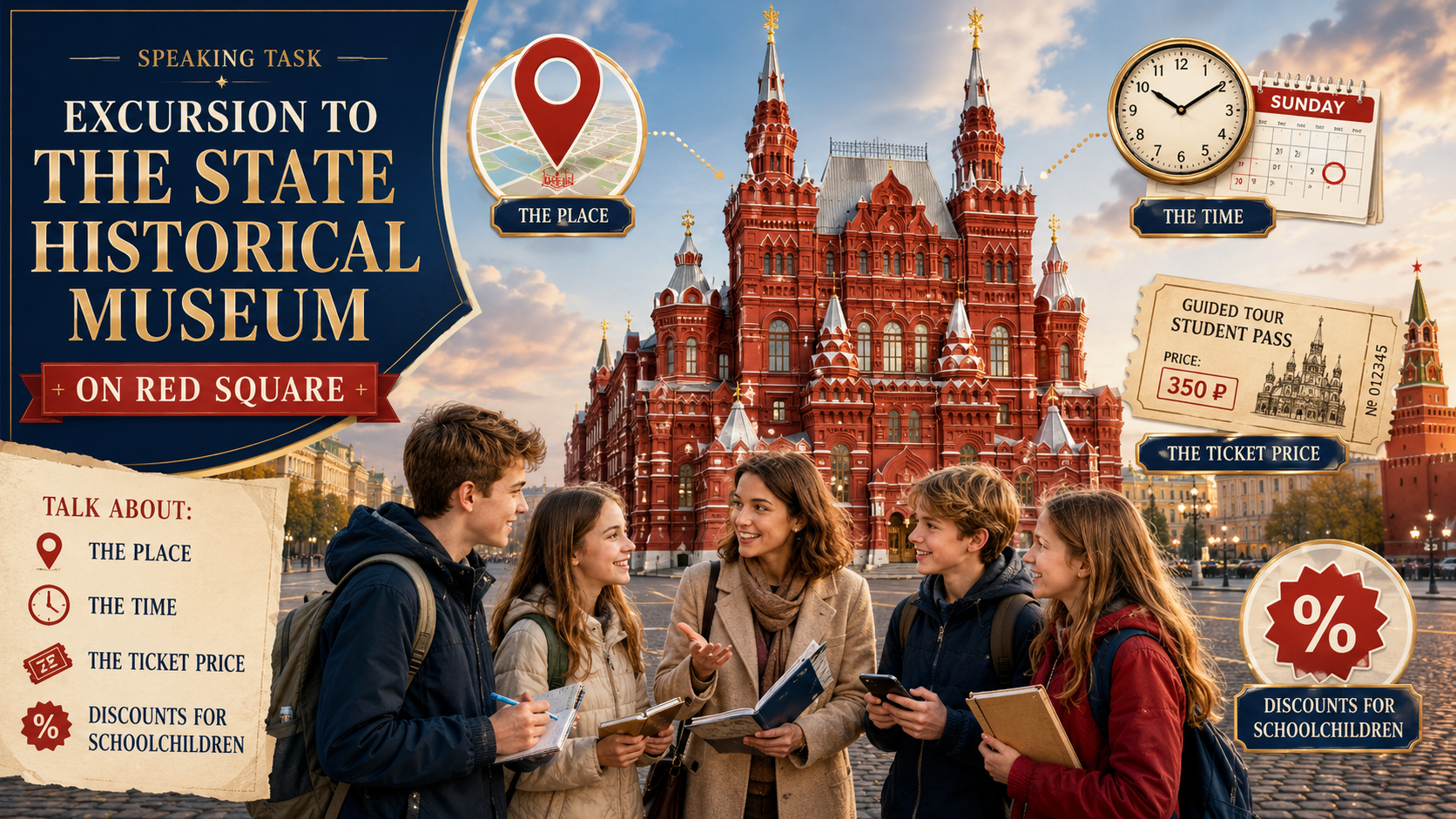
The State Historical Museum on Red Square
You are planning a visit with your class. Ask 4 direct questions about the 4 key-words shown on the advertisement above:
40 sec per answer · 2–3 phrases each · 1 phrase = 0 points
Topic: «A young Russian's view of history, culture and their country.»
1
Do you enjoy studying Russian history? Why or why not?
2
Who is your favourite Russian historical figure — and why?
3
Have you ever visited a historical museum? Tell me about it.
4
What Russian tradition do you like most? Why?
5
If you could time-travel to one period of Russian history, which one would you choose?
tap Start · goes through all 5 questions--:--
17
Speaking 4 · Voice message about your projectEGE устная 4 · В · 10 points
2.5 min prep · up to 3 min talk · 12–15 sentences · continuous speech · ≤ 7 = 0 points
Task 4 · Voice message about your project
Imagine that you and your friend are doing a school project «Ways of Exploring Russian Cities». You have found some photos to illustrate it, but for technical reasons you cannot send them now. Leave a voice message to your friend explaining your choice of the photos and sharing some ideas about the project.
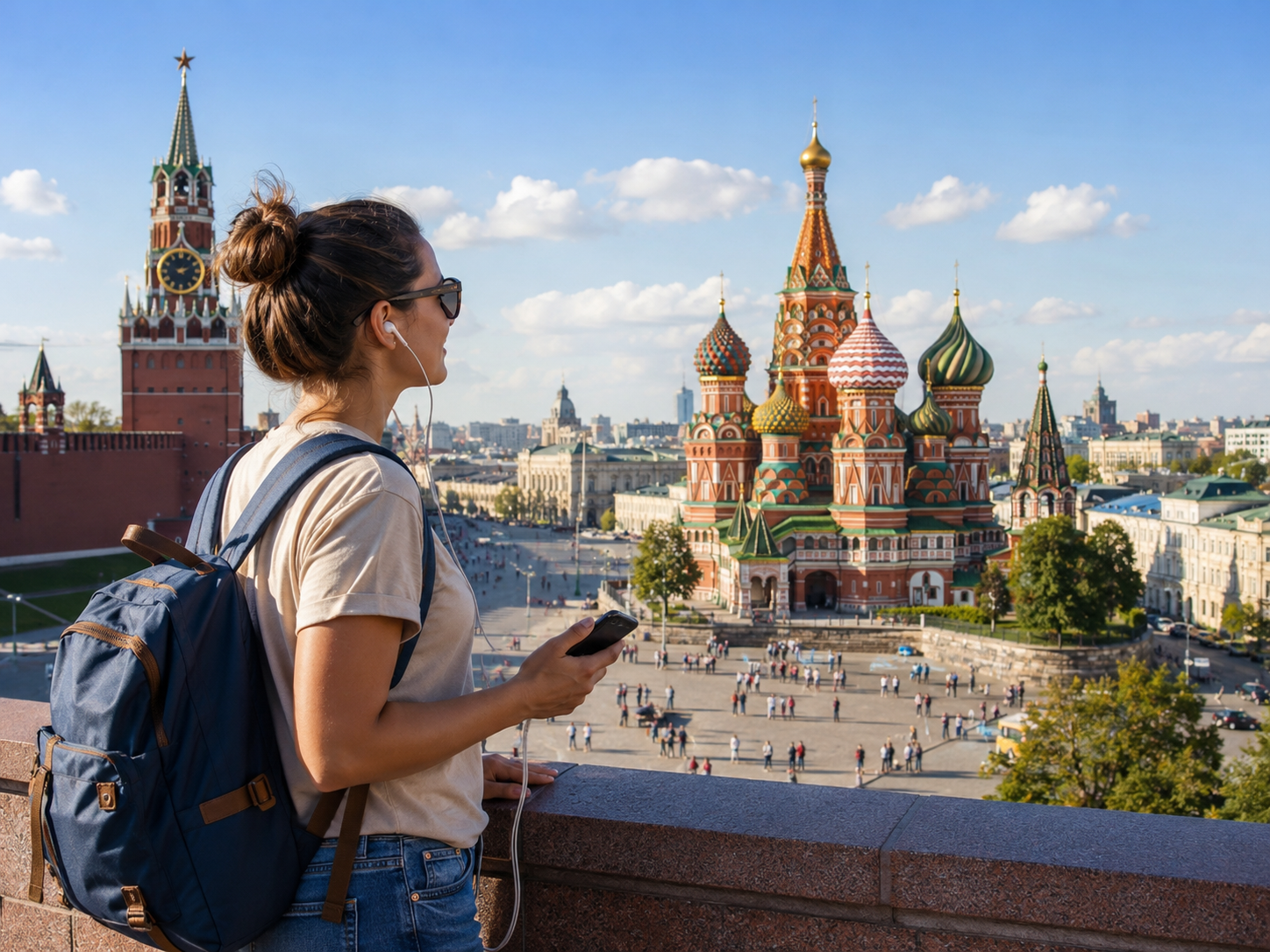
📸 Photo 1 shows a tourist exploring Moscow independently with an audio guide.
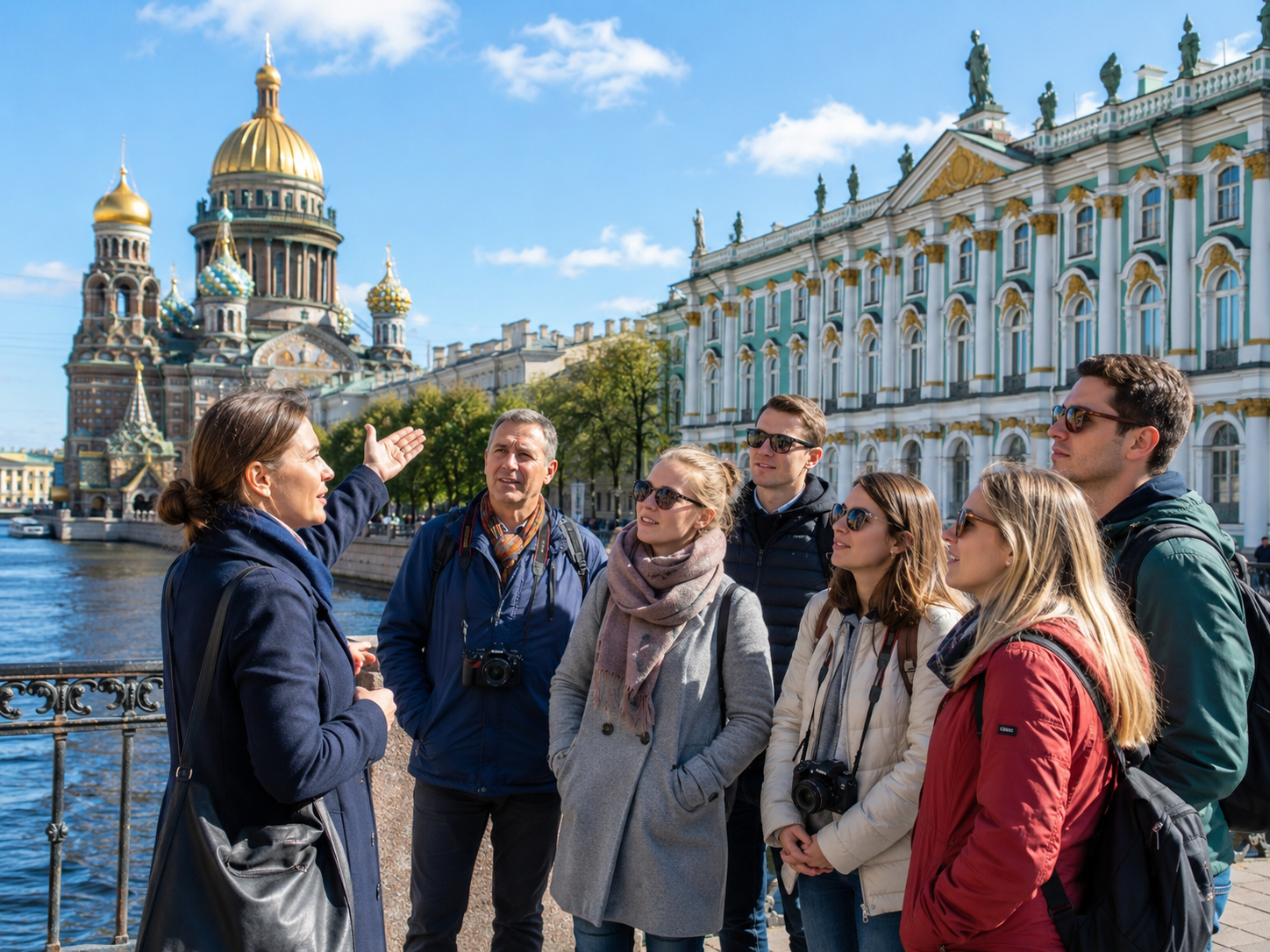
📸 Photo 2 shows a group of tourists sightseeing in Saint Petersburg with a professional guide.
In 2.5 minutes be ready to (12–15 sentences · continuous · ≤ 3 min)
Explain your choice of the illustrations for the project — briefly describe each photo and note the differences
1–2 advantages of exploring a city with an audio guide
1–2 advantages of exploring a city with a professional guide
1–2 disadvantages of both ways of sightseeing
Your opinion + preference — which way of exploring a city you would prefer, and why
tap to start preparation--:--
Task 4 traps:
❌ «On the first picture …» → ✅ «In the first picture …»
❌ «There is the tourist …» (first mention) → ✅ «There is a tourist …»
❌ ≤7 sentences → 0 points for the whole task
❌ 0 points on «Communicative task» → 0 for the whole task
❌ Don't add «I can't send photos because of technical problems» — that's the scenario, not part of your speech
Sample answer with linkers (open AFTER you've tried it!)
Hi! I've found two great photos for our project on «Ways of Exploring Russian Cities», and I'd like to share my thoughts on them.
In the first photo, we can see a young tourist standing on Red Square. She has a backpack and headphones — clearly she is exploring Moscow on her own with an audio guide. The second photo, on the other hand, shows a small group of tourists in Saint Petersburg, listening to a professional guide who is telling them about the Church on Spilled Blood. The main difference is obvious: the first tourist is alone and independent, while the second group depends on a real person.
Speaking of advantages, an audio guide gives you total freedom — you can stop, replay, or skip anything, and you can move at your own pace. A professional guide, however, offers something an app cannot: personal stories, answers to your questions, and a route built by someone who knows the city.
Of course, both ways have drawbacks too. With an audio guide, you can feel lonely and you may miss context that is not in the recording. With a professional guide, you have to follow the group's pace, and a bad guide can spoil the whole day.
Personally, I would prefer a professional guide, especially in a city with a rich history like Saint Petersburg. A living voice gives history colour that no recording can. To sum up, both formats work — but for me, a guided walk beats a headphone tour every time.
AI Live Coach · record yourself & get instant feedback
Tap Start recording and answer the project task aloud. As you speak, the system checks the ФИПИ criteria in real time. Re-record as many times as you want. Nothing leaves your browser.
⚠️ Live speech recognition is not supported in this browser. Open in Chrome or Edge on desktop for the full coach. You can still type your answer below.