Travel-themed hero banner — dark green background with a suitcase and colourful signposts on the left, an airplane, control tower and city skyline in the middle, and a backpack, compass, notebook, camera, hot-air balloon and Big Ben on the right. Travel-flavour cover for the Questions Deep Dive lesson.
Grammar Lab · Deep Dive · 03

Ask Me&Anything

Yes/No · Wh · Alt · Tag Polite ladder B1 · 90 MIN
B

Basics · Yes/No · Wh · Subject vs Object

rule → drill · every tense · travel-flavour
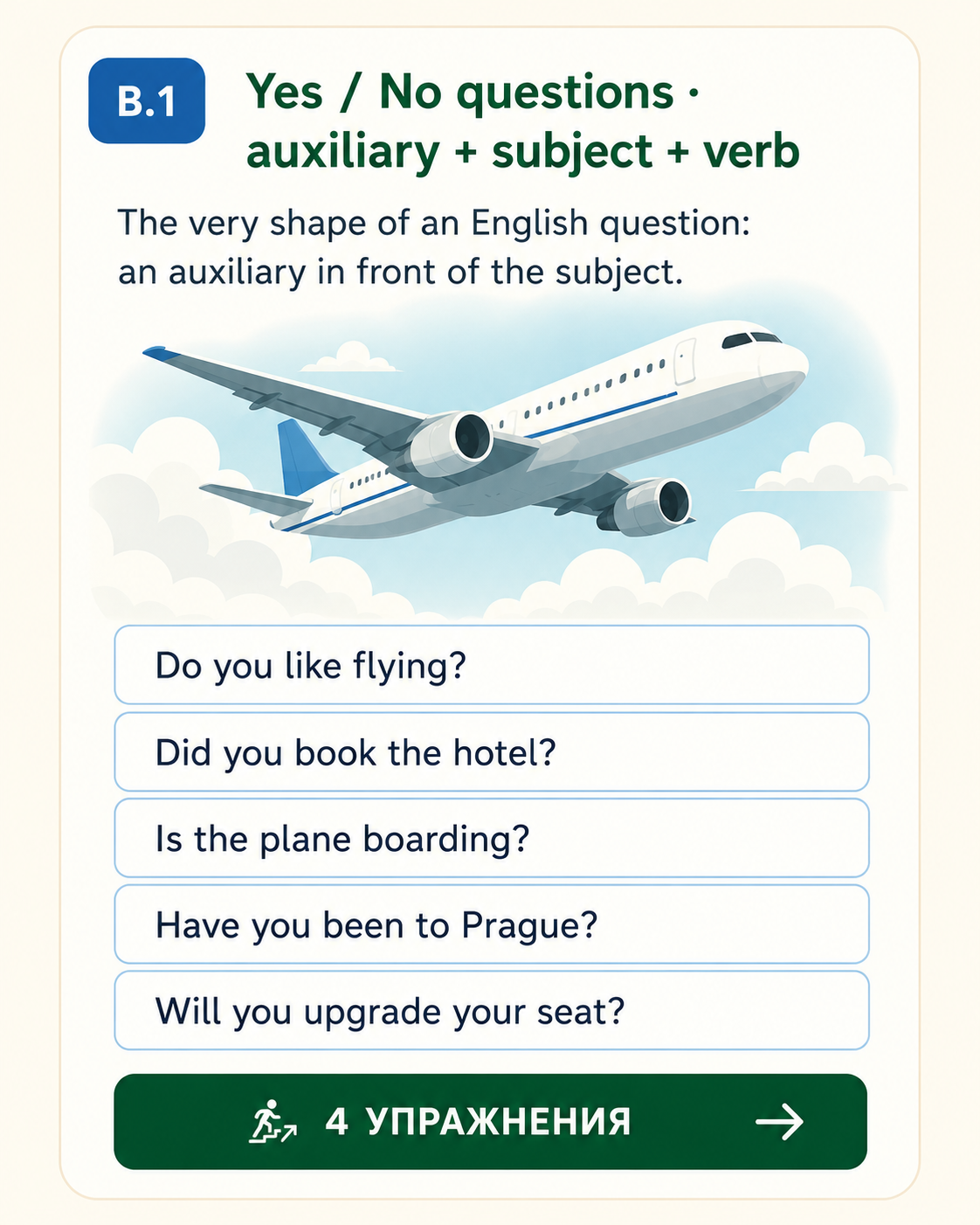
B.1 · Yes / No questions — auxiliary + subject + verb. The very shape of an English question: an auxiliary in front of the subject. Airplane in sky. Sample questions: Do you like flying? · Did you book the hotel? · Is the plane boarding? · Have you been to Prague? · Will you upgrade your seat?

B.1 Yes / No questions · auxiliary + subject + verb

The very shape of an English question: an auxiliary in front of the subject. Which auxiliary → depends on the tense.

  • Do / Does — Present Simple (main verb work / go / like)
  • Did — Past Simple (main verb in bare form: work, not worked)
  • Is / Am / Are — Present Continuous (main verb + -ing) & to-be states
  • Was / Were — Past Continuous / to-be states in the past
  • Have / Has — Present Perfect (main verb V3: been / seen / done)
  • Will — Future (main verb in bare form)
  • Are you going to — planned future / evidence
Do you like flying? · Did you book the hotel? · Is the plane boarding? · Have you been to Prague? · Will you upgrade your seat?
Правило: аукс перед подлежащим. Главный глагол потом. Никаких «Do you liked?» и «Are you booked?».
Not: «You like flying?» (без Do) — так спрашивают только очень informal. На B1/B2 — держим Do/Does/Did в начале.

B.1.a Choose the correct auxiliary · 10 items

Read the sentence — pick the auxiliary that matches the tense. Airport, hotel, taxi vocabulary throughout.

1. ___ you fly often for work? (habit → Present Simple)
2. ___ she booked the flight yet? (experience so far → Present Perfect)
3. ___ they staying at the same hotel this week? (right now → Present Continuous)
4. ___ you lose your suitcase in Rome? (finished past event)
5. ___ we take a taxi from the airport? (offer / decision now)
6. ___ your passport still valid? (state · to-be)
7. ___ you ever tried Turkish coffee? (life experience)
8. ___ you sleeping when the pilot announced the delay? (action in progress in the past)
9. ___ you send me the boarding pass tomorrow? (future promise · spoken)
10. ___ you going to check in online or at the counter? (pre-made plan)

B.1.b Build the Yes/No question · word-order drill · 8 items

Click words from the bank in the correct order. Every prompt tells you which tense. Reset per line if needed.
1. Ask if she speaks Italian (Present Simple)
?
2. Ask about tomorrow's flight (Present Continuous · fixed plan)
?
3. Ask about yesterday's taxi (Past Simple)
?
4. Ask about her whole life (Present Perfect · ever)
?
5. Ask about the hotel last week (Past · to-be state)
?
6. Ask for a promise (Future · will)
?
7. Ask about her plan (going to · pre-made plan)
?
8. Ask about the moment of take-off (Past Continuous)
?
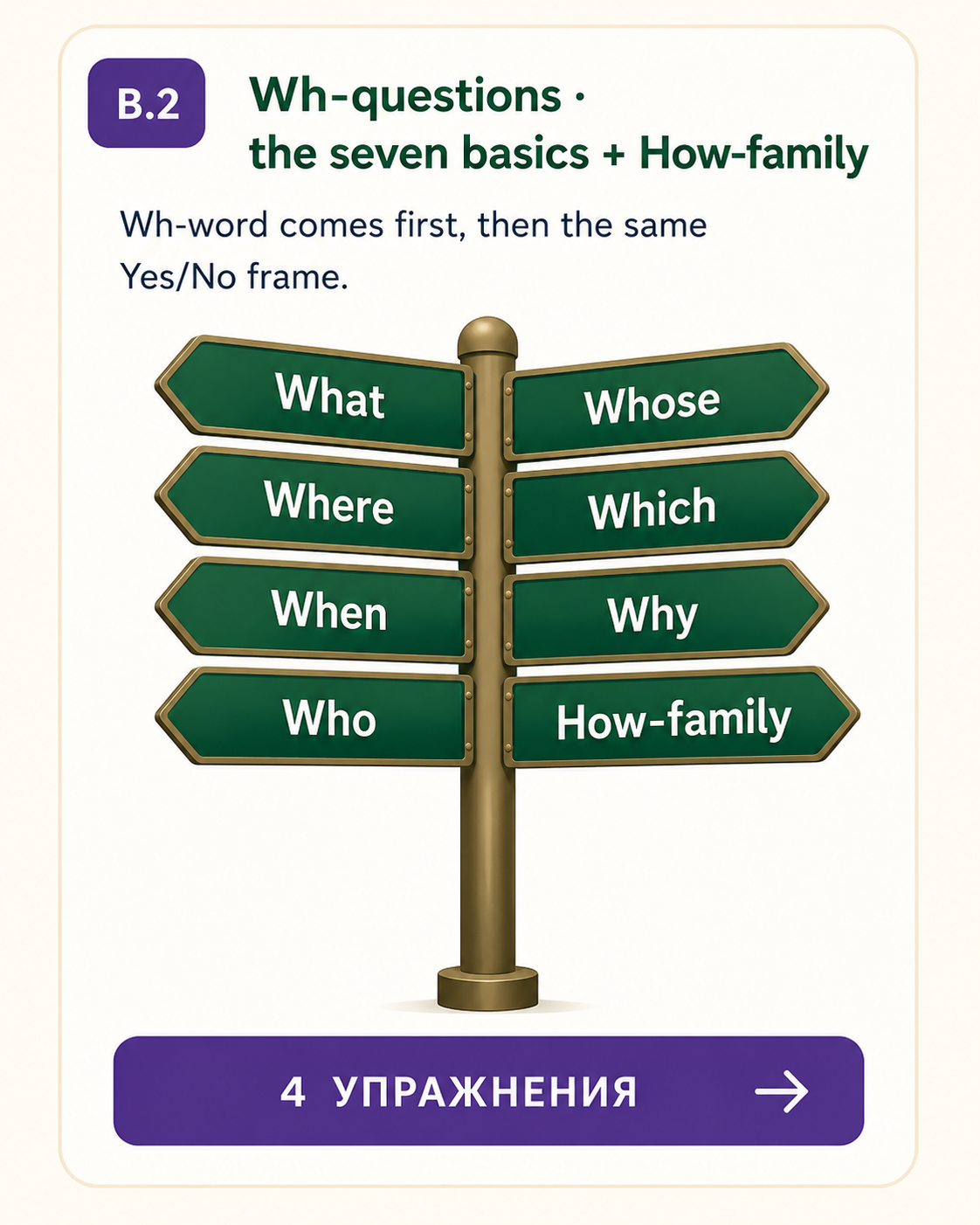
B.2 · Wh-questions — the seven basics + How-family. Wooden signpost with 8 arrows: What · Whose · Where · Which · When · Why · Who · How-family. Wh-word comes first, then the same Yes/No frame.

B.2 Wh-questions · the seven basics + How-family

Wh-word comes first, then the same Yes/No frame (auxiliary + subject + verb).

  • What — thing / activity (What did you order?)
  • Where — place (Where is your hotel?)
  • When — time (When does the flight land?)
  • Who — person (Who booked the tickets?)
  • Whose — belonging (Whose suitcase is this?)
  • Which — choice from a limited set (Which terminal, 1 or 2?)
  • Why — reason (Why is the flight delayed?)

How-family — measure / manner:

  • How — way / manner (How was the trip?)
  • How much — uncountable / price (How much is a taxi?)
  • How many — countable (How many bags do you have?)
  • How often — frequency (How often do you fly?)
  • How long — duration (How long is the flight?)
  • How far — distance (How far is the hotel from the airport?)
What time do you land? · Where are you staying? · How long is the layover?
Формула: Wh + Do/Does/Did/Is/Are/Have/Will + подлежащее + глагол.

B.2.a Fill the right Wh-word · 10 items

Read the answer / context — decide which Wh-word opens the question. Some sentences invite How much / How many / How long.

1. ___ is your seat number? (Answer: 24B)
2. ___ are you staying tonight? (Answer: at a small B&B)
3. ___ is the taxi to the centre? (Answer: about 30 euros)
4. ___ terminal do we need — 1 or 2? (Answer: 2)
5. ___ passport is on the table? (Answer: mine)
6. ___ do you travel abroad? (Answer: twice a year)
7. ___ is the flight to Bali? (Answer: about 12 hours)
8. ___ is your hotel from the airport? (Answer: 15 km)
9. ___ are you travelling with — family or friends? (Answer: my sister)
10. ___ is the flight delayed? (Answer: because of the weather)

B.2.b Build the Wh-question · word-order drill · 8 items

Same builder as B.1.b — but now with Wh-words in front.
1. Ask about her usual hotel (Present Simple)
?
2. Ask about the arrival time (Present Simple · schedule)
?
3. Ask about the taxi price yesterday (Past Simple)
?
4. Ask about the airline right now (Present Continuous)
?
5. Ask about her luggage (have got · possession)
?
6. Ask about the delay right now (Present Perfect · passive)
?
7. Ask about distance (to-be · state)
?
8. Ask about her Sunday plan (Future · will)
?
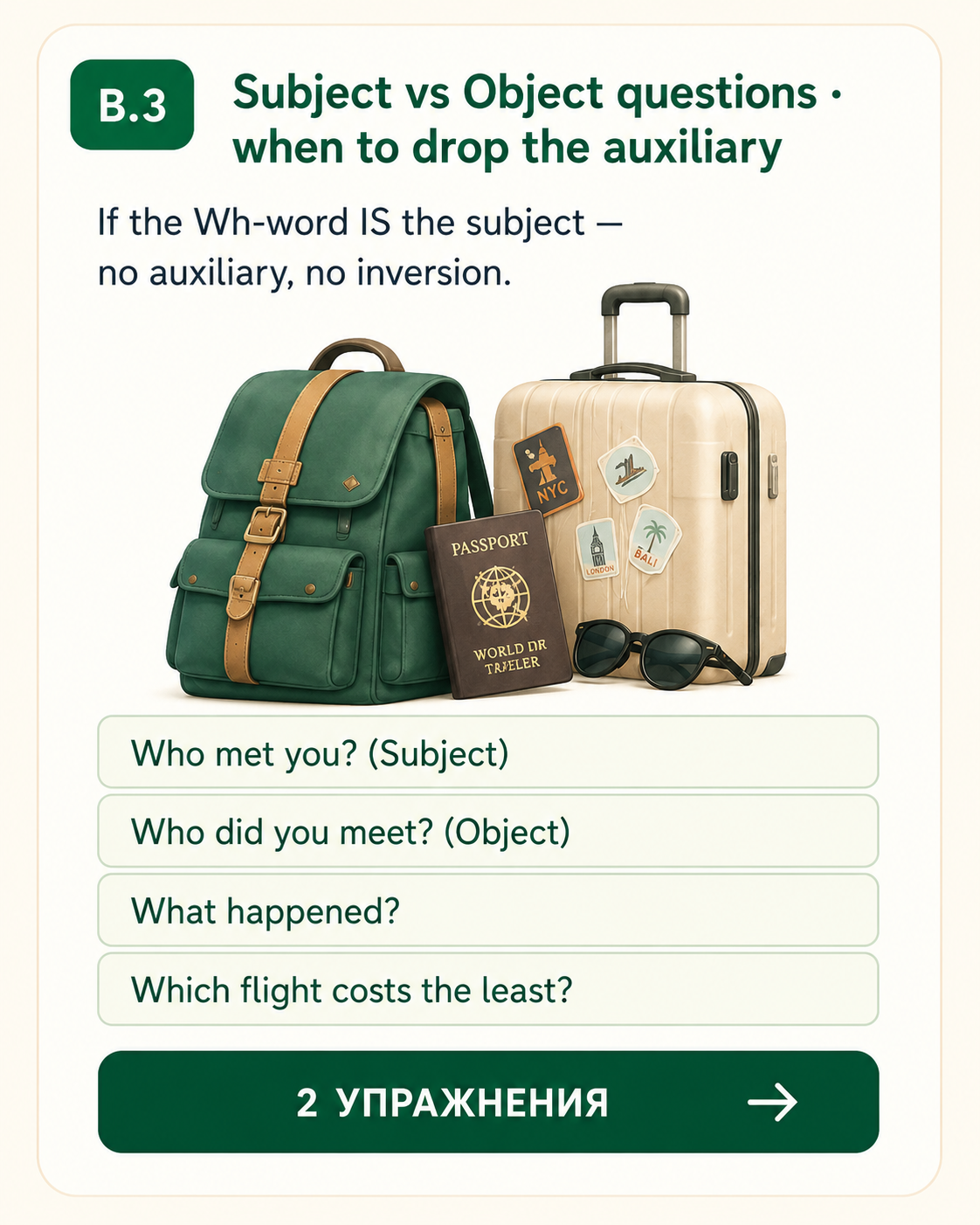
B.3 · Subject vs Object questions — when to drop the auxiliary. Green backpack + wooden suitcase with passport, sunglasses, world traveler sticker. If the Wh-word IS the subject — no auxiliary, no inversion. Examples: Who met you? (Subject) · Who did you meet? (Object) · What happened? · Which flight costs the least?

B.3 Subject vs Object questions · when to drop the auxiliary

If the Wh-word IS the subject — no auxiliary, no inversion. Just Wh + verb.

  • Object question: Who did you meet? → I met Anna. (Anna = object)
  • Subject question: Who met you? → Anna met me. (Anna = subject)

Same pattern with What, Which, How many:

What happened? · Who called you? · How many people booked this tour? · Which flight costs the least?
Правило: Wh-слово = подлежащее → вспомогательный НЕ нужен. Wh-слово = дополнение → нужен Do/Does/Did.
Test yourself: if the answer names a doer (Anna called me), the question is Subject. If the answer names a receiver (I called Anna), the question is Object.

B.3.a Subject or Object? Choose the correct form · 10 items

Read the answer under each question. Pick the version that fits the subject/object rule.
1. Answer: Anna booked the hotel.
2. Answer: She met the pilot.
3. Answer: The storm delayed the flight.
4. Answer: He photographed the temple.
5. Answer: Ten people took this tour last month.
6. Answer: I called my brother from the airport.
7. Answer: The cheapest flight leaves at 6 a.m.
8. Answer: They saw the Colosseum first.
9. Answer: My cousin lives in Vancouver.
10. Answer: I like historical museums the most.
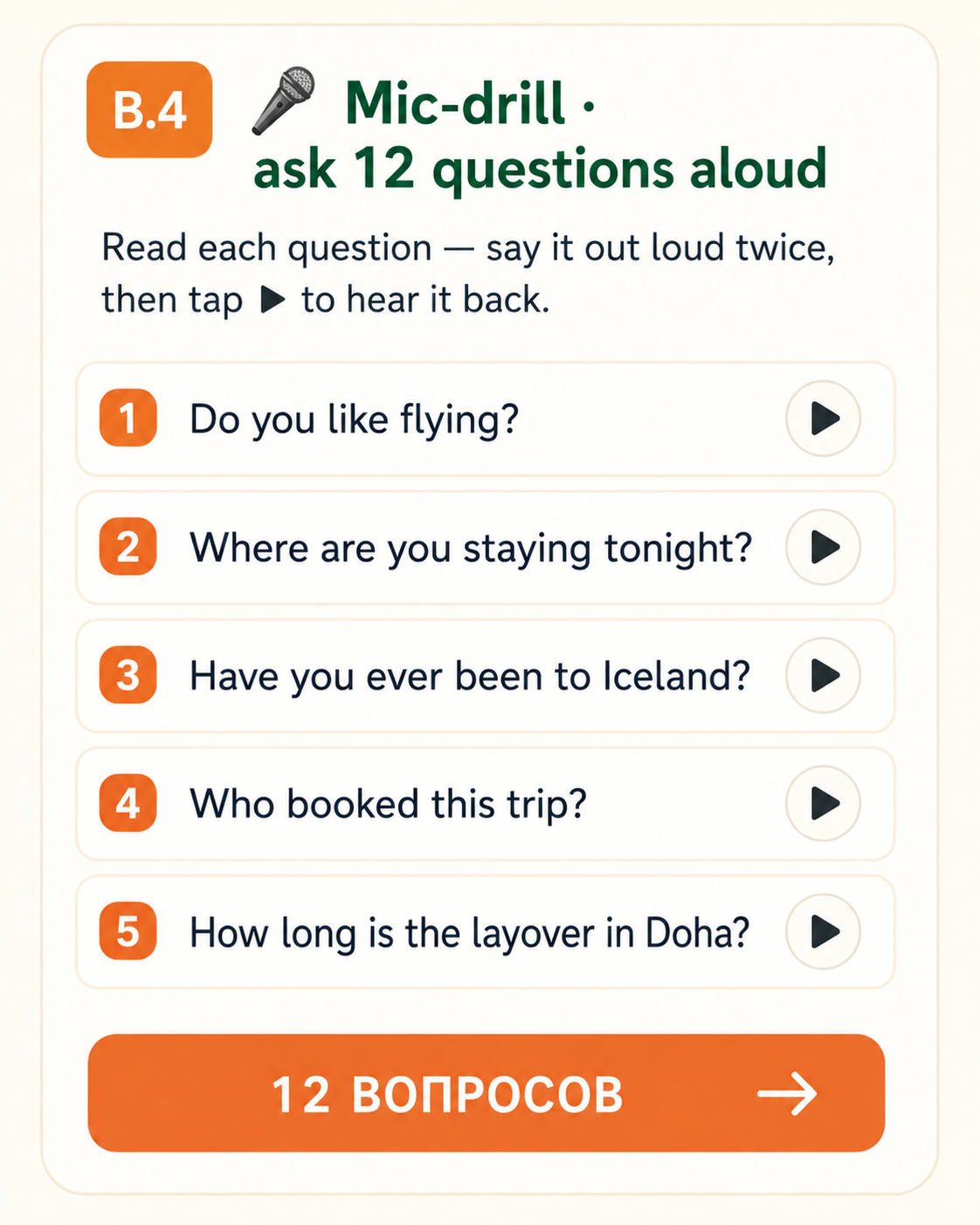
B.4 · Mic-drill — ask 12 questions aloud. Orange numbered list card with ▶ play buttons: 1. Do you like flying? 2. Where are you staying tonight? 3. Have you ever been to Iceland? 4. Who booked this trip? 5. How long is the layover in Doha? Big «12 ВОПРОСОВ →» button at the bottom.

B.4 🎤 Mic-drill · ask 12 questions aloud

Read each question — say it out loud twice, then tap ▶ to hear it back. Focus on falling intonation on Wh-questions and rising intonation on Yes/No.
1.Do you like flying? ↗ Yes/No
2.Where are you staying tonight? ↘ Wh
3.Have you ever been to Iceland? ↗ Yes/No
4.Who booked this trip? ↘ Wh · Subject
5.How long is the layover in Doha? ↘ Wh
6.How much did the taxi cost from the airport? ↘ Wh
7.Are you going to rent a car in Rome? ↗ Yes/No
8.What time does the museum close? ↘ Wh
9.Which terminal do we need — one or two? ↘ Wh · Alt
10.Did they announce the gate yet? ↗ Yes/No
11.How often do you travel for work? ↘ Wh
12.Whose passport is this? ↘ Wh
Intonation cue Yes/No → rising ↗ ("Do you… ↗?") · Wh → falling ↘ ("Where are you… ↘?") · Alternative → rise on first option, fall on second ("Terminal 1 ↗ or 2 ↘?")
A

Advanced · Alternative · Tag · Polite · Indirect

tone → politeness → precision
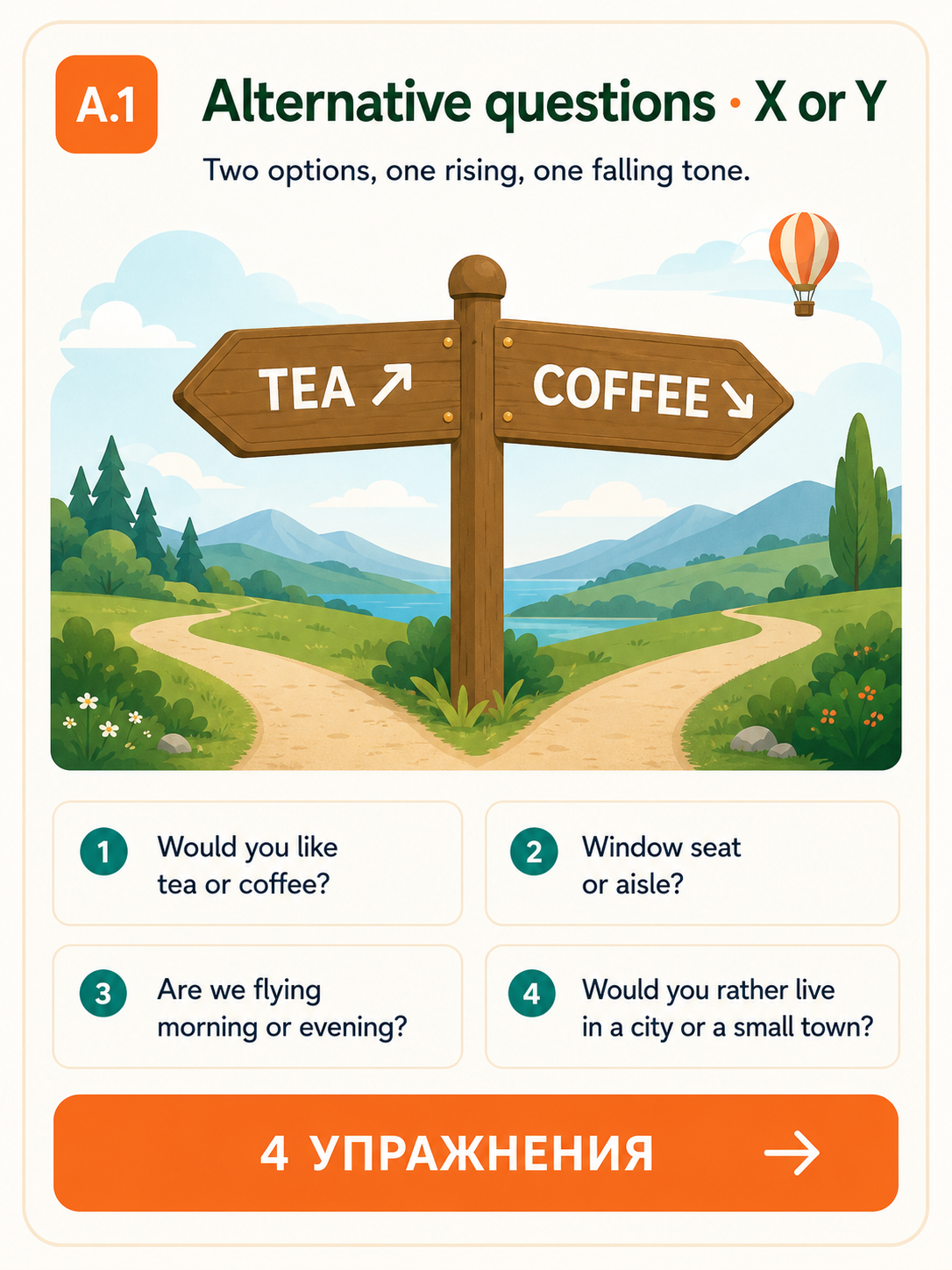
A.1 · Alternative questions · X or Y — wooden signpost with two arrows TEA ↗ and COFFEE ↘, hot-air balloon. Two options, one rising, one falling tone.

A.1 Alternative questions · X or Y

Same frame as a Yes/No question, but with or offering two options. Intonation: rise on X, fall on Y.

Would you like tea ↗ or coffee ↘? · Are we flying morning ↗ or evening ↘? · Do you prefer the window ↗ or the aisle ↘?
Строим как Yes/No вопрос, но добавляем «or Y». Голос: ↗ на первое слово, ↘ на второе.
Answer is NOT «Yes» / «No». The listener must pick one: "Tea, please." Not «Yes, please» — that would mean neither.

A.1.a Match a good alternative question · 8 items

Pick the version that sounds like a real alternative question — not a Yes/No.
1. You are offering a window vs aisle seat.
2. You are choosing between morning and evening flight.
3. You are asking about taxi vs subway.
4. You are picking Italy vs Spain for holidays.
5. Asking about payment method.
6. Choosing between mountains and sea.
7. Deciding tea vs coffee at the hotel.
8. Asking about staying vs going out.
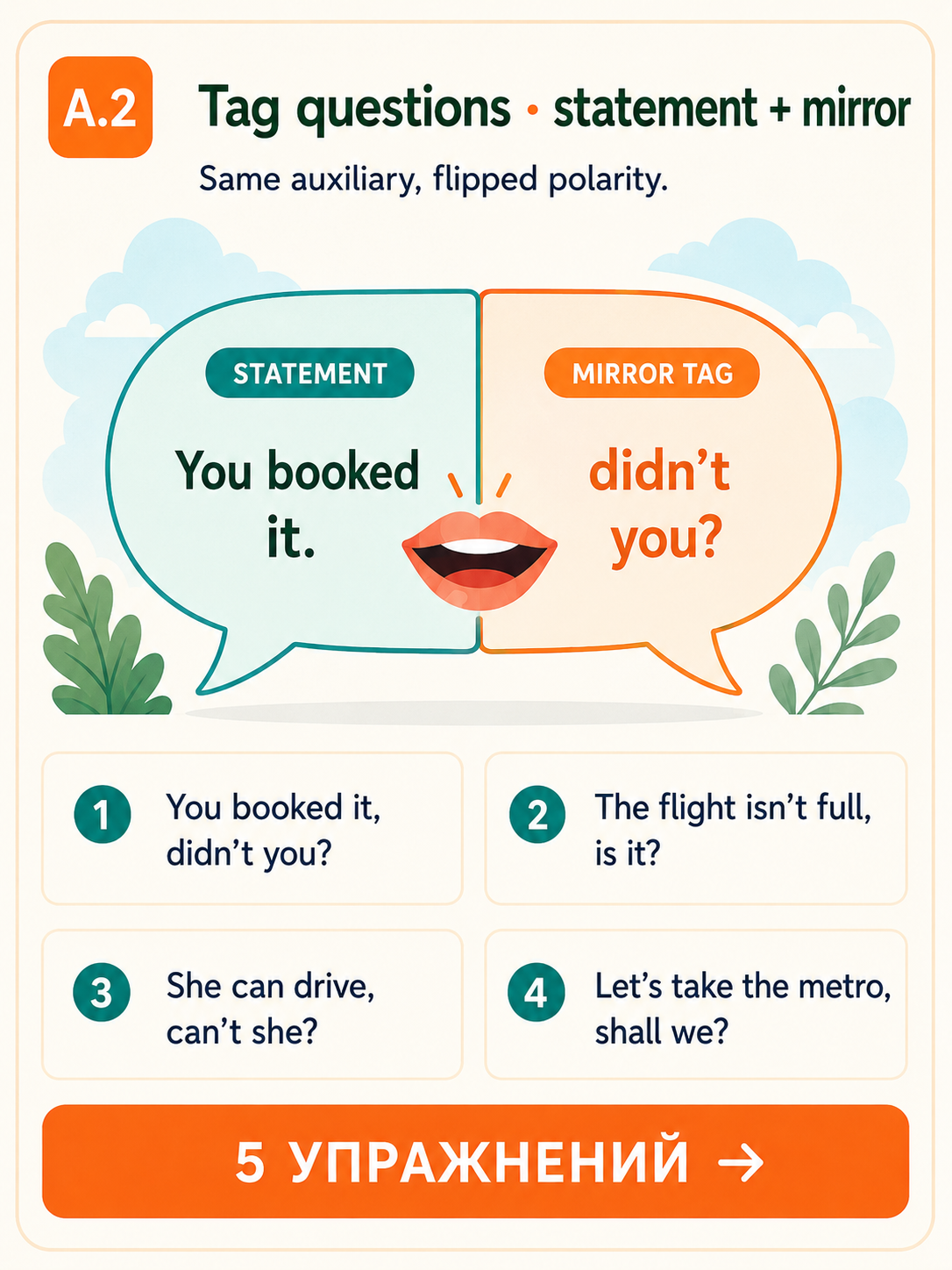
A.2 · Tag questions · statement + mirror — green speech bubble STATEMENT «You booked it» + orange speech bubble MIRROR TAG «didn't you?», smiling lips in the middle. Same auxiliary, flipped polarity.

A.2 Tag questions · positive → negative, negative → positive

A tag question is a mini-question at the end of a statement, asking for confirmation. The auxiliary in the tag mirrors the statement, but flips polarity.

  • Positive → negative tag: You are Katya, aren't you?
  • Negative → positive tag: The flight isn't full, is it?

Which auxiliary to pick? Repeat the auxiliary of the statement:

  • Present Simple + main verb → use do/does/don't/doesn'tYou like flying, don't you?
  • Past Simple + main verb → use did/didn'tThey booked the tour, didn't they?
  • Any modal / auxiliary → repeat it — You can drive, can't you? / She has already checked in, hasn't she?
You booked the hotel, didn't you? · The flight isn't full, is it? · Katya can speak German, can't she?
Хвост зеркалит утверждение: аукс тот же, знак наоборот. Интонация вниз ↘ = «жду подтверждения». Вверх ↗ = «реально спрашиваю».
Two curious exceptions: «I am… → aren't I?» (not amn't I). «Let's… → shall we

A.2.a Choose the correct tag · 10 items

Read the statement — pick the tag that mirrors auxiliary and flips polarity.
1. You like travelling by train, ___?
2. The taxi isn't here yet, ___?
3. She has already checked her bags, ___?
4. You'll call me when you land, ___?
5. The kids were sleeping, ___?
6. Katya can speak German, ___?
7. They didn't book the tour last week, ___?
8. Let's take the metro, ___?
9. I'm on the right platform, ___?
10. This hotel doesn't have a pool, ___?
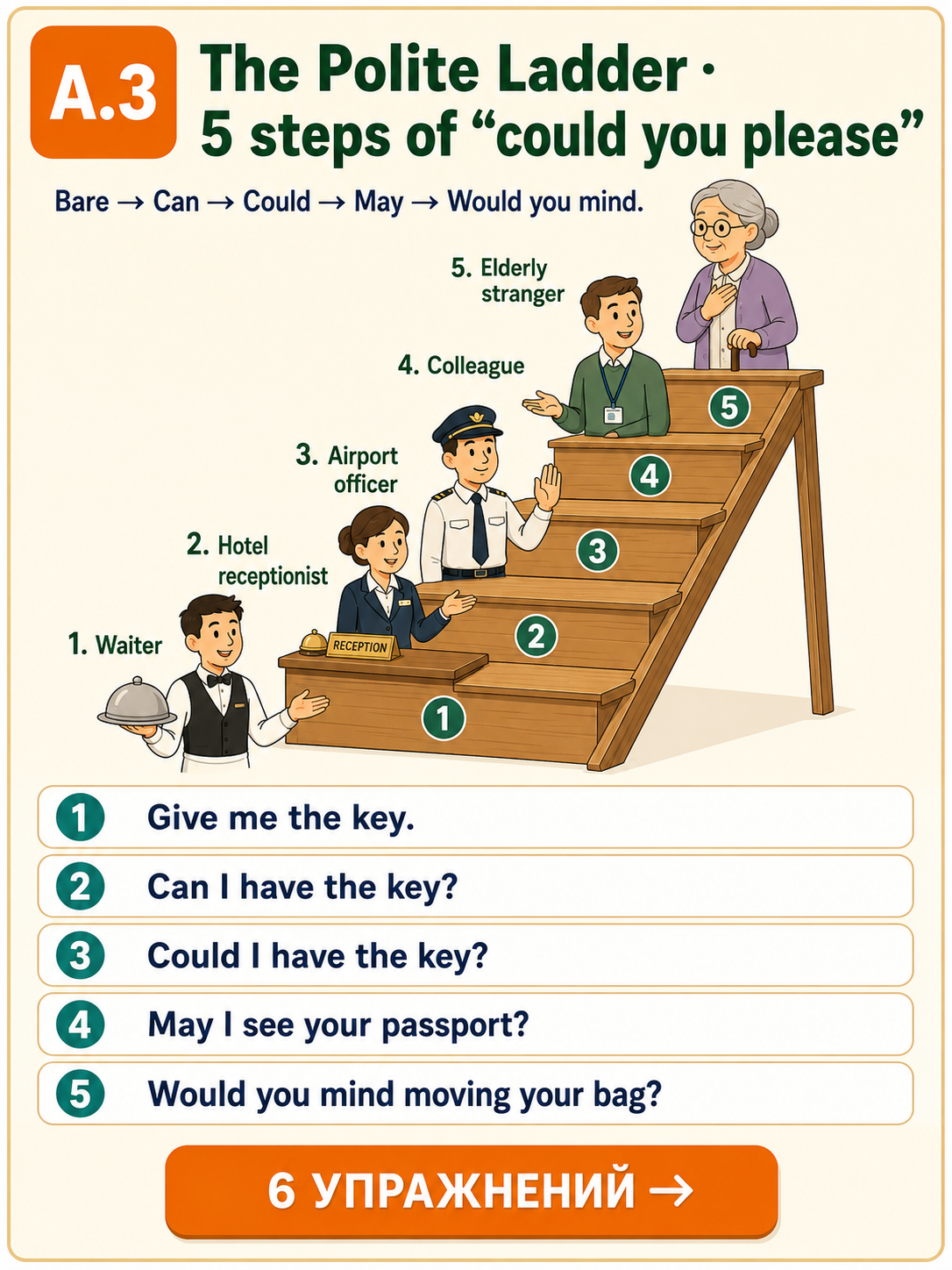
A.3 · The Polite Ladder · 5 steps of «could you please» — wooden 5-step ladder: 1 Waiter · 2 Hotel receptionist · 3 Airport officer · 4 Colleague · 5 Elderly stranger. Bare → Can → Could → May → Would you mind.

A.3 The Polite Ladder · 5 steps of «could you please»

Native English builds politeness in visible steps. Learn the ladder — climb it depending on who you're talking to and how much you're asking.

  1. Direct (bare) · casual — «Pass the salt.» / «Open the window.» → for family and close friends only.
  2. Can I / Can you · neutral — «Can I have a coffee? / Can you help me?» — everyday tone with strangers.
  3. Could I / Could you · polite — «Could I have a coffee? / Could you help me?» — most hotels, cafés, airports.
  4. May I · formal — «May I have your passport, please?» — official contexts, older register.
  5. Would you mind + -ing / I was wondering if… · very polite / careful — «Would you mind moving your bag? / I was wondering if you could recommend a good restaurant.»
Casual: Give me your ticket. · Neutral: Can I see your ticket? · Polite: Could I see your ticket, please? · Formal: May I see your ticket? · Very polite: Would you mind showing me your ticket?
Формула: чем выше уровень — тем менее прямо звучит. Отель / кафе / аэропорт → минимум Could I / Could you.
«Would you mind + -ing» → форма герундий, НЕ инфинитив: «Would you mind opening the window?», не «Would you mind to open…».

A.3.a Rank the polite ladder · match request to level · 10 items

For each context, pick the most appropriate polite version.
1. Café · asking for water · neutral tone
2. Hotel reception · asking for the key · polite
3. Airport security · officer asking for passport · formal
4. Plane · asking a stranger to move their bag · very polite
5. Restaurant · asking for the bill · polite standard
6. Tourist info · asking for a restaurant tip · careful/very polite
7. Taxi · giving destination · neutral
8. Hotel · asking for a late check-out · polite
9. Waiter comes with your dish · asking for extra napkins · neutral
10. Meeting a colleague's parent for the first time · asking to sit · polite/formal
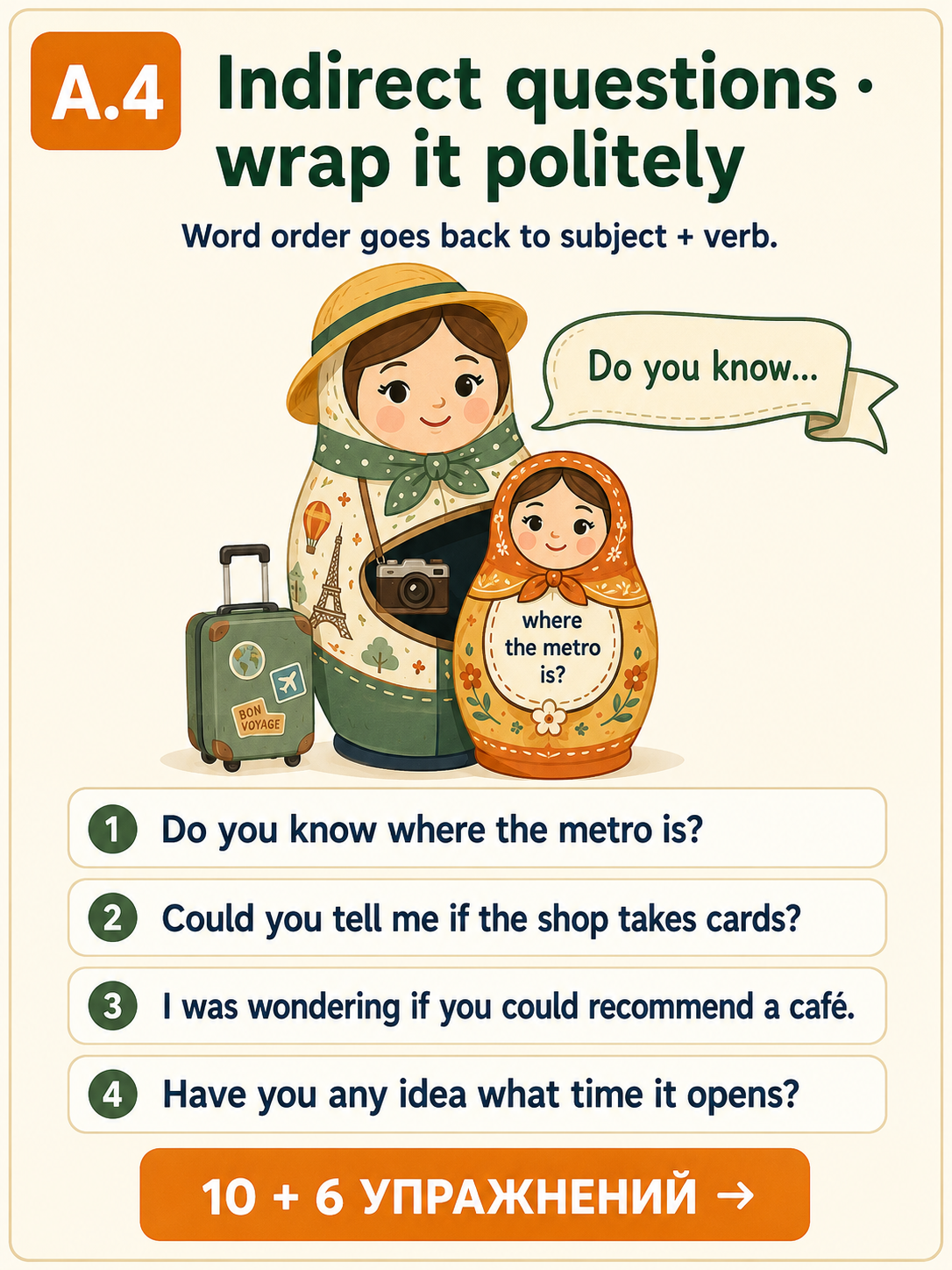
A.4 · Indirect questions · wrap it politely — two matryoshka dolls in travel outfits: outer polite doll with speech ribbon «Do you know…», inner doll shows the direct «where the metro is?». Word order goes back to subject + verb.

A.4 Indirect questions · wrap a question inside a polite frame

Direct: Where is the bus stop? → Indirect: Do you know where the bus stop is?

What changes:

  • Word order switches back to subject + verb (no more auxiliary inversion inside).
  • For Yes/No questions, use if or whether: Do you know if the shop is open?
  • «Do you know», «Could you tell me», «I was wondering», «I'd like to know», «Have you any idea…» — all valid openers.
Direct: Where is the metro? → Indirect: Could you tell me where the metro is?
Direct: Does the shop take cash? → Indirect: Do you know if the shop takes cash?
Внутри косвенного вопроса — обычный порядок как в утверждении. Никаких «is the metro», «does the shop take» после «где / если».
Very common mistake: «Could you tell me where is the metro?» — no. Correct: «Could you tell me where the metro is

A.4.a Turn direct → indirect · 10 items

Choose the correctly-formed indirect version. Watch the word order after «where / when / if».

1. Direct: Where is the check-in counter?
2. Direct: Does the shop take cards?
3. Direct: When does the museum open?
4. Direct: How much is a taxi to downtown?
5. Direct: Are they still boarding?
6. Direct: What time is the next train?
7. Direct: Has she called the taxi yet?
8. Direct: Why is the flight delayed?
9. Direct: Do I need a visa?
10. Direct: Where can I buy a SIM card?

A.4.b Build the polite indirect · word-order drill · 6 items

Same builder as in Basics — click the words in the right order. Inside «Do you know», «Could you tell me» — no inversion.
1. Where is the metro? → polite indirect
?
2. Does the shop take cards? → polite indirect (Yes/No)
?
3. How much is a taxi? → very polite
?
4. When does the museum open? → polite indirect
?
5. Do I need a visa? → polite indirect
?
6. Where can I buy a SIM card? → polite indirect
?
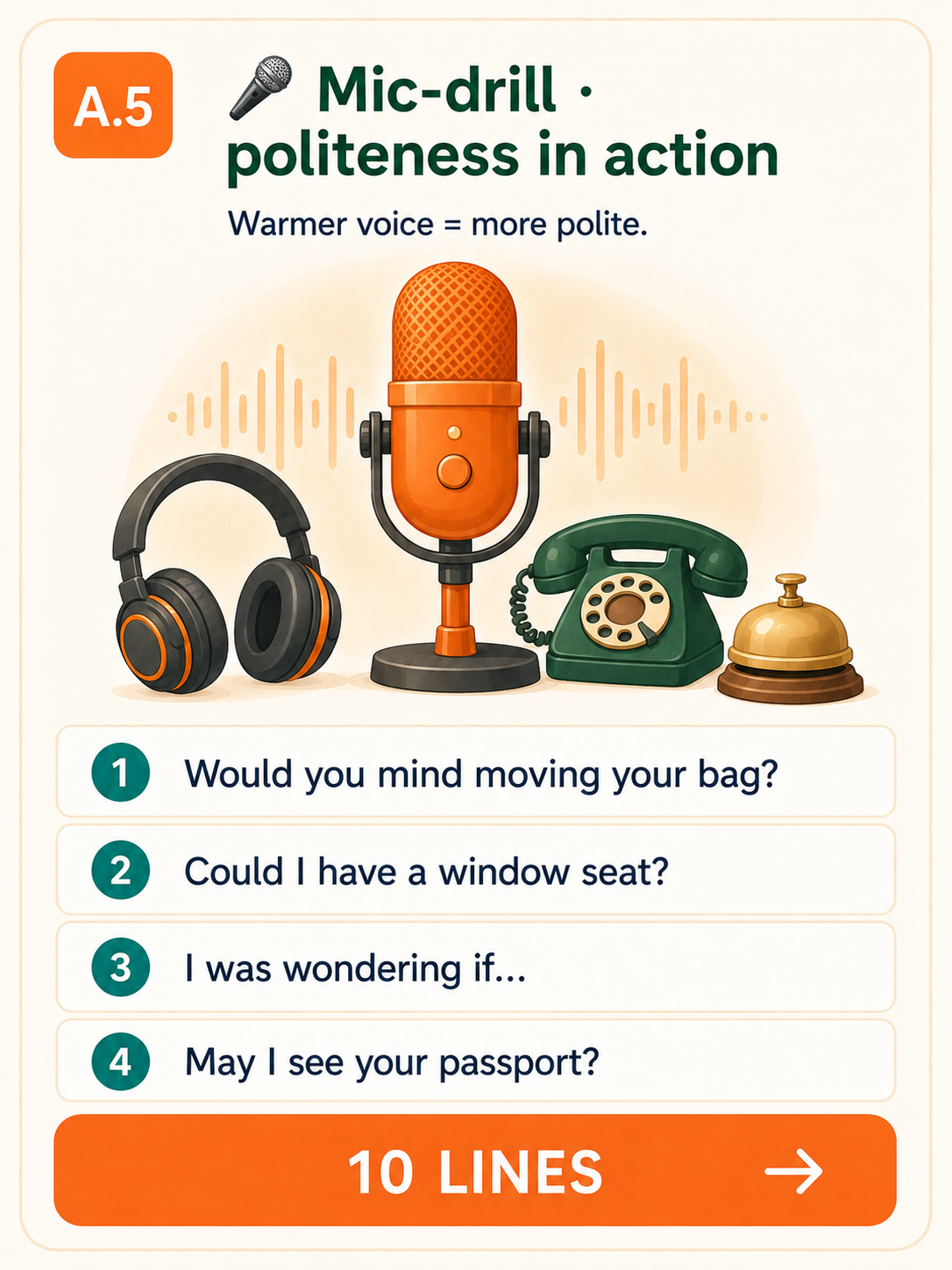
A.5 · Mic-drill · politeness in action — orange podcast microphone with orange sound waves, black headphones, red vintage rotary phone, small hotel bell. Warmer voice = more polite.

A.5 🎤 Mic-drill · politeness in action · 10 lines

Say each line aloud twice — once as direct, once as polite. Then tap ▶ to compare with a native voice. Notice the smoother musical shape of the polite versions.

1.Would you mind moving your bag a little?
2.Could I have a window seat, please?
3.I was wondering if you could recommend a restaurant.
4.May I see your passport, please?
5.Do you know if the shop is still open?
6.Could you tell me where the metro is?
7.Would you like tea or coffee? ↗ tea, ↘ coffee
8.You booked the hotel, didn't you? ↘ confirming
9.Have you any idea why the flight is delayed?
10.Could I possibly have a late check-out?
Voice tip Polite English lives in the voice: soften the vowels, pull the pitch down at the end, breathe between clauses. Faster ≠ ruder — flatter and lower = ruder. Warmer and rounder = more polite.
🚂

Word Order · «Паровоз» · SVOMPT + Frequency adverbs

Афанасьева / Михеева · вагончики

WO.1 The Locomotive · вагончики английского предложения

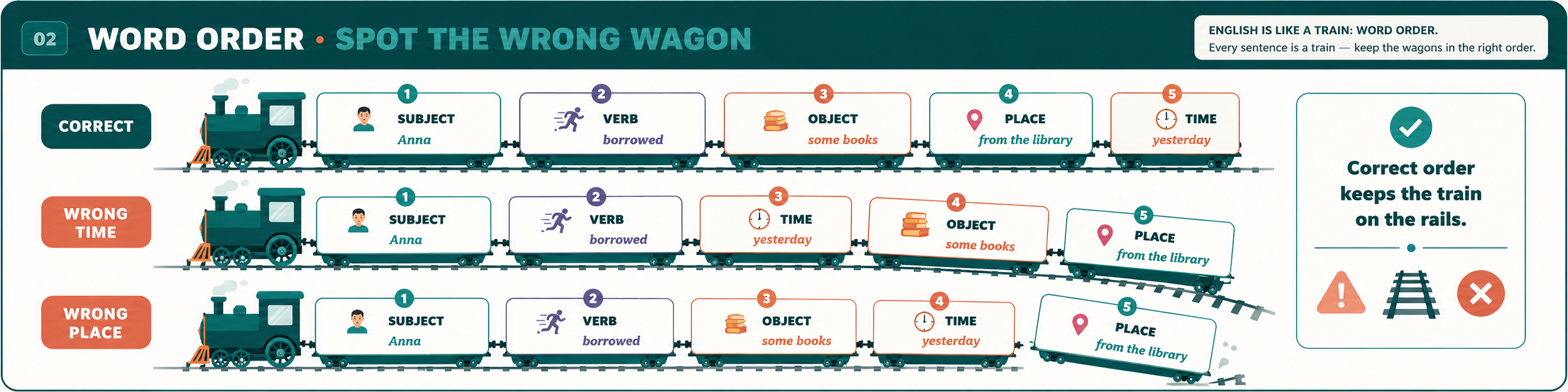
English is strict about word order. Every sentence is a train — вагончики стоят в одном порядке.
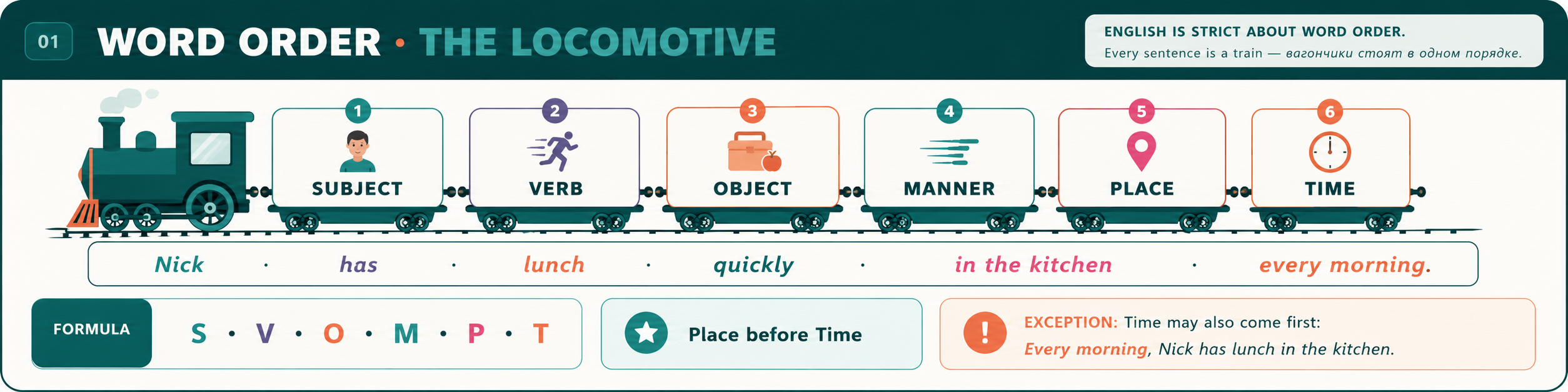
Word Order · The Locomotive — 6 wagons: Subject (Nick) · Verb (has) · Object (lunch) · Manner (quickly) · Place (in the kitchen) · Time (every morning). Formula S·V·O·M·P·T. Exception: Time may also come first.
🚂 who?
SUBJECT
Nick
🎬 does what?
VERB
has
📦 what?
OBJECT
lunch
💫 how?
MANNER
quickly
📍 where?
PLACE
in the kitchen
🕐 when?
TIME
every morning
Nick has lunch quickly in the kitchen every morning. ← every wagon in its place.
S · V · O · M · P · T — субъект · глагол · объект · манера · место · время. Правило-«паровоз»: если поменять вагончики местами, поезд с рельсов.
Two exceptions: (1) Time can also stand at the very start: «Every morning, Nick has lunch in the kitchen.» — comma required. (2) Place and Time together = Place first, Time second (never «every morning in the kitchen»).

WO.1.a Spot the wrong wagon · 10 items

Spot the Wrong Wagon — three trains: CORRECT (Anna · borrowed · some books · from the library · yesterday), WRONG TIME (Anna · borrowed · yesterday · some books · from the library — Time out of place), WRONG PLACE (Anna · borrowed · some books · yesterday · from the library — Place after Time). Correct order keeps the train on the rails.

Read each sentence — one has a wagon out of order. Pick the correct version.
1. Nick / has lunch / every morning / in the kitchen.
2. Anna / borrowed / some books / from the library / yesterday.
3. Nelly / has been / in London / since June.
4. We / will be flying / over the ocean / tomorrow morning.
5. They / go / to the park / on Sundays.
6. I / met / Mike / in 1990 / in Rome.
7. The children / were playing / quietly / in the garden / all afternoon.
8. She / read / the letter / carefully / at the table.
9. My brother / has canned / a lot of fruit / since August.
10. The Niagara Falls / attract / a lot of tourists / every summer.

WO.1.b Build the sentence · «Собери паровоз» · 8 items

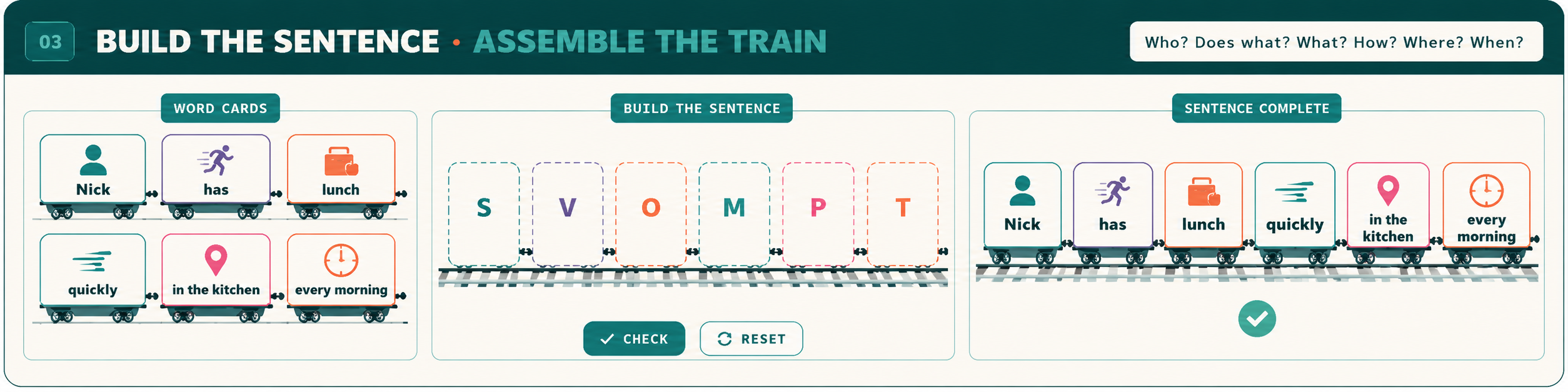
Build the Sentence · Assemble the Train — three columns: WORD CARDS (Nick, has, lunch, quickly, in the kitchen, every morning), BUILD (empty S · V · O · M · P · T slots with Check / Reset), SENTENCE COMPLETE (assembled train with all 6 wagons in the right order).

Click the wagons in the correct order. Every prompt tells you the tense.
1. Nick / lunch · kitchen · every morning (Present Simple habit)
.
2. Anna / books · library · yesterday (Past Simple)
.
3. Nelly / London / June (Present Perfect)
.
4. We / ocean · tomorrow morning (Future Continuous)
.
5. I / Mike · Rome · 1990 (Past Simple · Place → Time)
.
6. She / letter · carefully · table (SVOMP)
.
7. The children / quietly · garden · all afternoon (Past Simple · SVMPT)
.
8. Niagara Falls / tourists · every summer
.

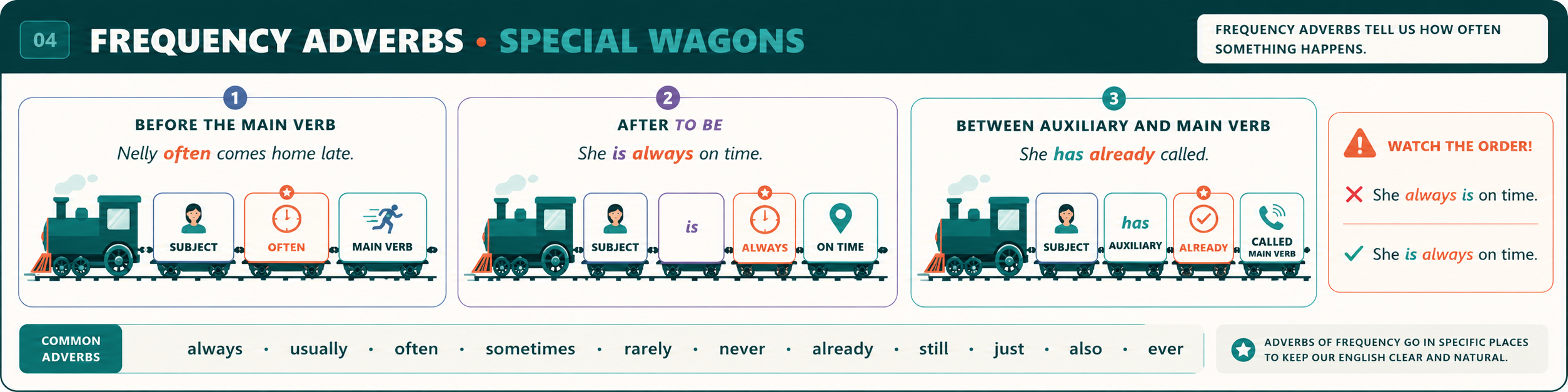
WO.2 Frequency adverbs · где стоят слова частотности

Frequency Adverbs · Special Wagons — three positions: 1) BEFORE THE MAIN VERB (Nelly often comes home late) · 2) AFTER TO BE (She is always on time) · 3) BETWEEN AUXILIARY AND MAIN VERB (She has already called). Common adverbs: always · usually · often · sometimes · rarely · never · already · still · just · also · ever.

These are special wagons — they NEVER sit in the SVOMPT chain. They have their own rule.

The full family:

always · usually · often · sometimes · rarely · seldom · never · already · still · just · both · also · all · ever
Слова частотности сидят вплотную к главному глаголу: перед смысловым, но после to be / после первого вспомогательного.
Common mistake: «She always is on time.» → wrong. «She is always on time.» → correct. To be = always after.

WO.2.a Place the frequency adverb · 10 items

Pick the version with the adverb in the right slot.
1. Nelly / comes home late / often
2. She / feels sad / sometimes
3. She / is / on time / always
4. Bill / is / ill / also
5. They / have / arrived / just
6. We / live in Moscow / all
7. They / are at home / on Sundays / never
8. She / has / called / already
9. I / drink cappuccino / rarely
10. You / can / use the app / also

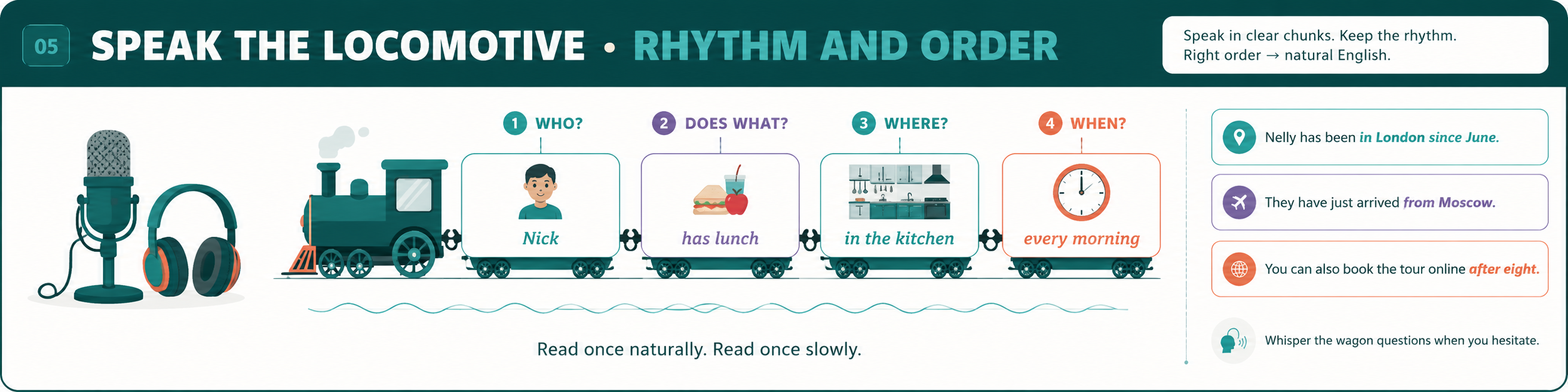
WO.3 🎤 Speak the locomotive aloud · 10 lines

Speak the Locomotive · Rhythm and Order — 4 wagons: WHO? (Nick) · DOES WHAT? (has lunch) · WHERE? (in the kitchen) · WHEN? (every morning). Mic + headphones on the left. Speak in clear chunks. Right order = natural English.

Every line is a full SVOMPT sentence — read it once naturally, once slowly. Tap ▶ to hear the model.
1.Nick has lunch in the kitchen every morning. S · V · O · P · T
2.Anna borrowed some books from the library yesterday.
3.Nelly has been in London since June.
4.We will be flying over the ocean tomorrow morning.
5.I met Mike in Rome in 1990.
6.She always feels sad and unhappy in the evening. frequency + place + time
7.They have just arrived from Moscow.
8.Bill is also ill today.
9.The Niagara Falls attract a lot of tourists every summer.
10.You can also book the tour online after eight.
Micro-technique When you hesitate, whisper «who? does what? what? where? when?» to yourself — the paravozik pulls the words in the right order automatically.
🎧

Reading + Listening · questions in real context

read → hear → answer → discuss
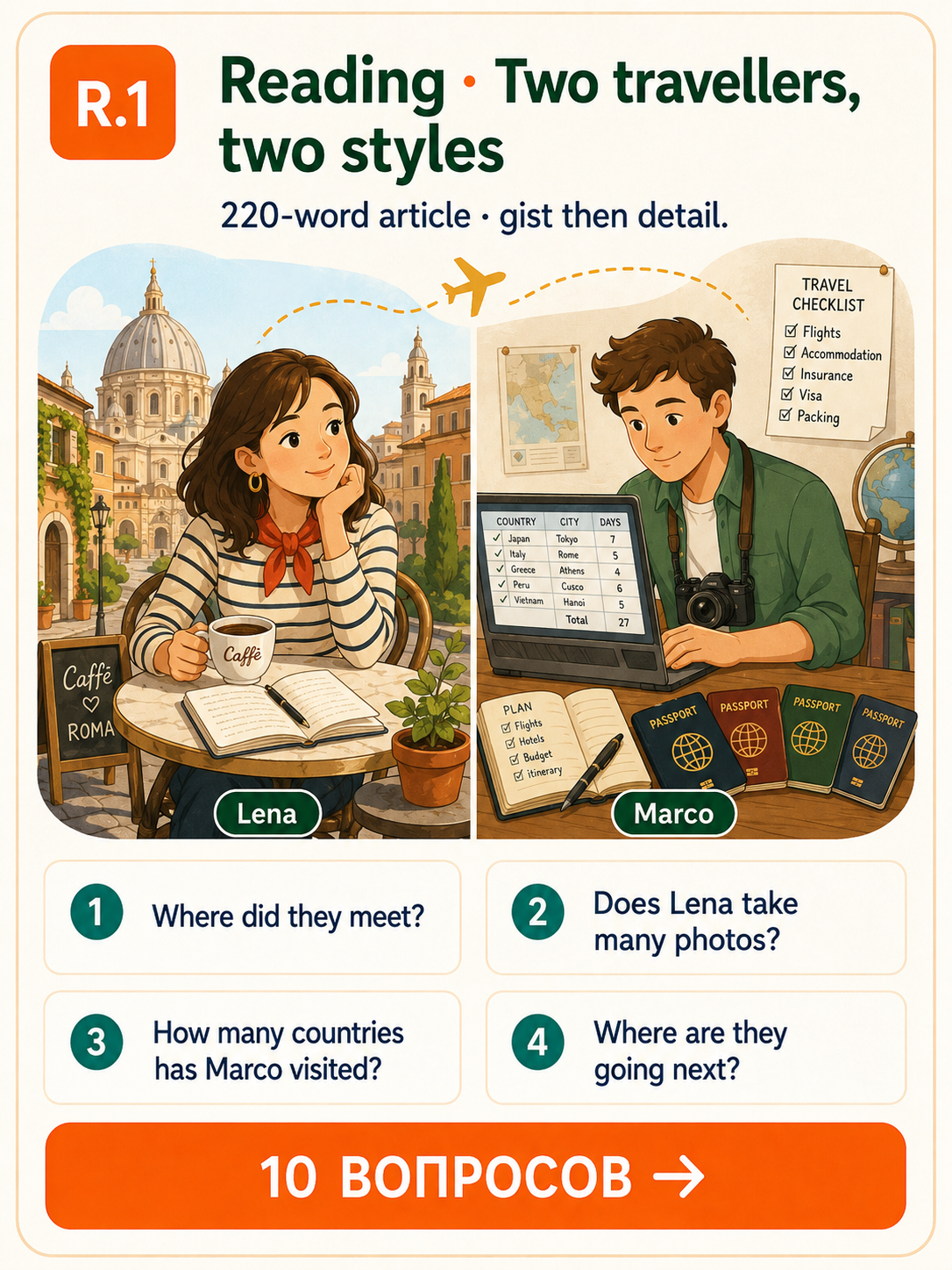
R.1 · Reading · Two travellers, two styles — split scene: left half Lena at a Rome café with a cappuccino and a notebook (Caffè Roma), right half Marco with a spreadsheet of countries, a camera, three passports and a Travel Checklist. Yellow airplane trail connects both. 220-word article, gist then detail.

R.1 Reading · «Two travellers, two styles»

Read the article twice: first for gist (who is who?), then for detail. Only then answer the 10 mixed questions below — Yes/No · Wh · Subject/Object · Alternative · Tag · Indirect.

  • Gist reading: speed up. Skip words you don't know. Grab the shape: Who is Lena? Who is Marco? What happened?
  • Detail reading: slow down. Circle numbers, names, dates: how many countries? which trip? what changed?
  • Watch the question type before you answer — a Yes/No question wants a yes/no answer, a Wh-question wants a fact, an Indirect question sneaks the answer inside politeness.
Lena's own words: «I want to feel the city, not to collect it.» — a whole personality in ten words. Notice how a good writer packs identity into a single quote.
Совет: сперва пробежать глазами (gist), потом вернуться и подметить цифры и имена (detail). Читать один раз и сразу отвечать — почти всегда ловушка на B1.

R.1.a Article · 220 words · B1

Two travellers, two styles

Lena and Marco met at a hostel in Rome three years ago. Lena is a slow traveller: she books one place, stays for two weeks, learns the names of the café owners on her street, and rarely takes photos. «I want to feel the city, not to collect it,» she says.

Marco is the opposite. He is a checklist traveller: seven countries a month, two hundred photos a day, and a spreadsheet where he ranks every restaurant. He has already visited forty-three countries; Lena has visited eleven.

Last summer they decided to travel together to Iceland. It was a disaster and a revelation at the same time. On day one, Marco wanted to drive around the whole ring road; Lena wanted to sit by a single glacier and read. On day three, they compromised: they moved once every two days and cooked their own meals in each hostel.

By the end of the trip, Lena had taken more photos than usual, and Marco had learnt three Icelandic words. «I think we changed each other a little,» Lena says. «Not enough to swap styles — but enough to understand.»

They're planning a second trip. This time, Georgia. Marco is already reading about Tbilisi. Lena is looking for a small village with a river.

R.1.b Comprehension · 10 questions · mixed types

Choose the answer that matches the article. Notice which question types you meet.

1. Where did Lena and Marco meet? (Wh)
2. Does Lena take many photos? (Yes/No)
3. How many countries has Marco visited so far? (Wh · Present Perfect)
4. Who suggested the compromise on day three? (Subject question)
5. Was the Iceland trip a success or a disaster? (Alternative)
6. Marco ranks restaurants in a spreadsheet, doesn't he? (Tag)
7. Could you tell me where they're going next? (Indirect)
8. What did Marco learn during the Iceland trip? (Wh)
9. Who is reading about Tbilisi already? (Subject question)
10. Have they finished changing each other? (Yes/No)

R.1.c Write 3 questions ABOUT the article · practice

Now flip the exercise — write 3 of your OWN questions about Lena and Marco. Use different types. Type them below.

Model: Have you ever travelled with someone whose style is opposite to yours? / Would you rather be a slow traveller or a checklist traveller?

Your Q1 (Yes/No):

Your Q2 (Wh + tense):

Your Q3 (Indirect / polite):
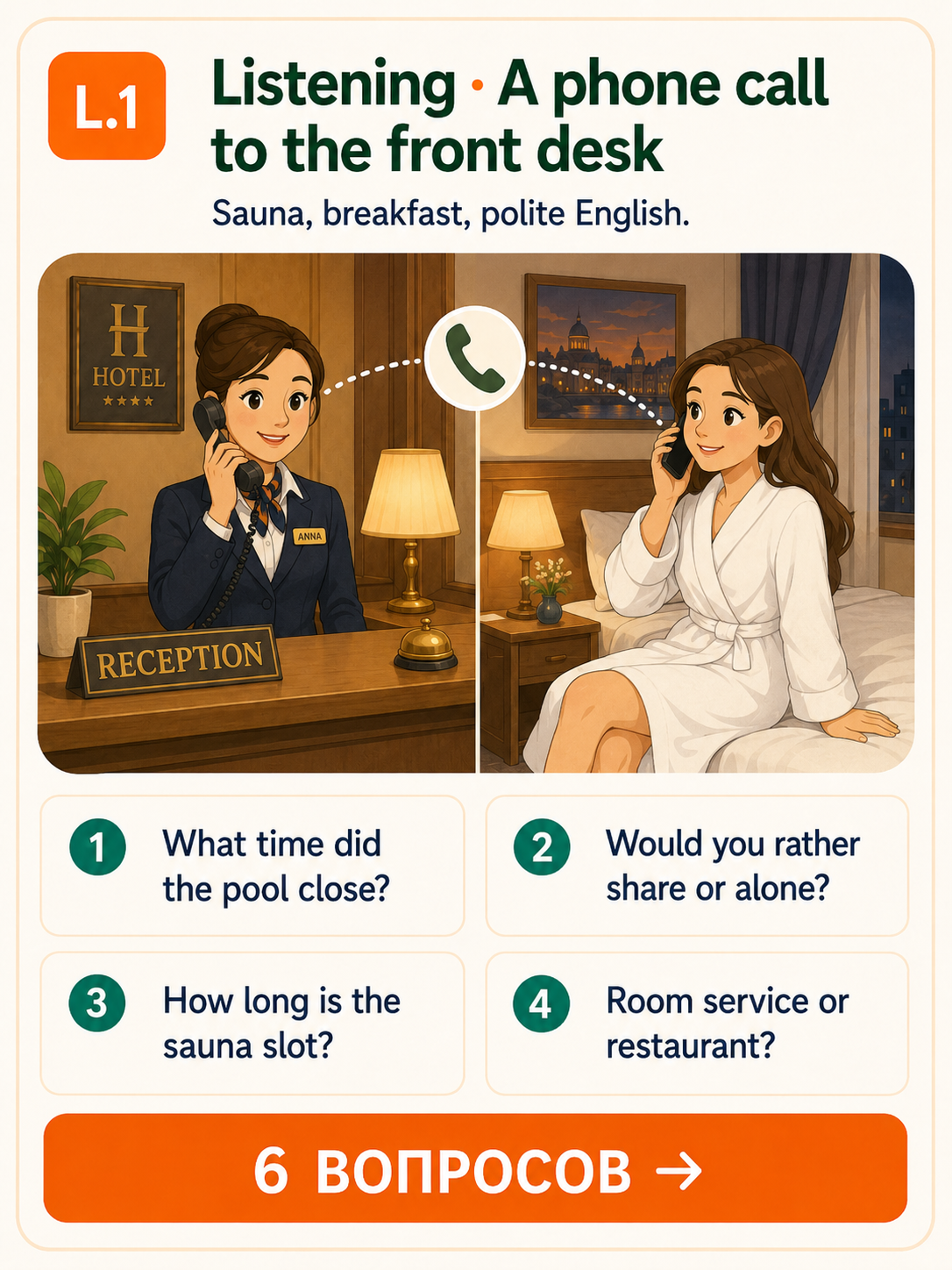
L.1 · Listening · A phone call to the front desk — split scene: hotel receptionist Anna at the reception desk with a phone, dashed line to Katya in a bathrobe on the edge of a hotel bed, evening lamp light. Sauna, breakfast, polite English.

L.1 Listening · «A phone call to the front desk»

A short evening dialogue between a hotel guest (Katya, room 304) and the front-desk receptionist (Anna). Click ▶ to play the whole scene twice — once for gist, once for detail.

  • Listen for question types. Every polite request in this scene uses one — Yes/No, Wh, Alternative, Indirect. Try to catch them.
  • Watch for softeners: «I was wondering if…», «Could I…», «Would you like me to…», «Would you rather…» — these are the same tools we drilled in the Advanced tab, but now spoken naturally.
  • Sub-tasks: Sauna · breakfast · pool. Track what closes, what opens, what gets booked.
Katya's opening: «Hi Anna. This is Katya from room 304. I'm sorry to call so late. I was wondering if the pool is still open.» — three polite frames in one line: self-introduction · apology · indirect question. That's the register you're building.
Совет: первое прослушивание — общий сюжет (что просит Катя, что отвечает Анна). Второе — детали (время, номер комнаты, время сауны). Только потом отвечать.

L.1.a Listen twice · then answer

Tap ▶ for the whole scene. Then answer 6 questions. Turn on subtitles only after your first try.

1. What time did the pool close? (Wh)
2. Katya used a very polite frame. Which one? (Indirect)
3. Does Katya want to share the sauna? (Yes/No)
4. Anna offered an alternative. Which question type is «Would you rather share or have it to yourself?»
5. How long is Katya's sauna slot? (Wh · How long)
6. Is breakfast served in the room only, in the restaurant only, or both? (Alt)

L.1.b 🎤 Role-play · take Katya's part · 6 lines

Play only Anna's lines (▶). Say Katya's lines out loud. Feel how polite the whole call sounds — every request wrapped in Could / Would / I was wondering.

1. Anna:Front desk. Good evening, how can I help you? → Katya: Hi. This is Katya from room 304…
2. Anna:The pool closed at nine. But the sauna is open. → Katya: Could I book a slot?
3. Anna:Would you rather share or have it to yourself? → Katya: By myself, please…
4. Anna:I'll block the slot. Is there anything else? → Katya: Yes, actually. Do you know if…
5. Anna:Both are available. → Katya: Perfect. Thank you so much.
6. Anna:Have a great evening. → Katya: Thanks, you too. Good night.
Polite voice check Say every Katya line twice: once businesslike, once soft and warm. Feel the difference — same words, two different personalities. Aim for warm.
W

Workbook · Big Mix + Growth Points

50+ items · every question type · travel setting

W.1 Your growth points · fix the five most common question mistakes

Every B1 learner hits the same five walls with questions. Learn to notice them — you'll edit yourself in real time.

  1. Auxiliary missing · «You like flying?» → Do you like flying?
  2. Auxiliary doubled · «Did you liked it?» → Did you like it?
  3. Word order inside indirect · «Could you tell me where is the metro?» → Could you tell me where the metro is?
  4. Subject question · extra Do/Does · «Who did call you?» → Who called you?
  5. Tag polarity · «You are Katya, are you?» → You are Katya, aren't you?
Rule of thumb: after Do/Does/Did → base verb. After Have/Has → V3. After Is/Are/Was/Were → -ing or adjective. Fix the auxiliary first, everything else follows.

W.2 Big Mix · 30 MCQ · Yes/No · Wh · Subject/Object · Alt · Tag · Polite · Indirect

One pass, no clues. Every item mixes tenses and question types. Aim for 25+ out of 30.

1. ___ you ever been to Croatia?
2. ___ is the flight from Moscow to Tbilisi?
3. Who ___ this route yesterday?
4. ___ you ___ me back once you land?
5. Would you prefer to sit by the window ___ by the aisle?
6. Katya can speak Italian, ___?
7. Could you tell me ___ the museum ___?
8. ___ the taxi arrived while you were checking in?
9. ___ moving your suitcase, please?
10. ___ many people were at the check-in this morning?
11. The gate hasn't been announced yet, ___?
12. ___ language do people speak in Zurich?
13. Do you know ___ the shop takes euros?
14. ___ the museum open on Mondays?
15. ___ has just called me from the taxi?
16. I ___ if you could recommend a good café.
17. ___ your friend renting a car for the trip?
18. Where ___ Katya go on Sundays?
19. ___ this hotel got a swimming pool?
20. ___ the coffee, or would you rather have tea?
21. ___ suitcase is that on the belt — mine or yours?
22. Did you say the train is on time, ___?
23. ___ take pictures inside the cathedral?
24. ___ you like the room, madam?
25. ___ people booked this tour last summer?
26. Let's take the shuttle bus, ___?
27. ___ your first time in Georgia?
28. Have you any idea ___ the next bus leaves?
29. ___ possibly help me with the code, please?
30. ___ these seats free?

W.3 Travel dialogue · airport check-in · fill 12 gaps

You're checking in for a flight to Athens. Read the whole scene once, then fill each blank with the right question word or auxiliary. Word bank below.

W.3.a Airport check-in · 12 gaps · type or tap

Bank: Do · Does · Did · Is · Are · Have · Where · When · How much · How many · Could · Would. Case-insensitive.

Agent: Good morning. ___[1] I have your passport, please?

You: Sure, here it is.

Agent: Thank you. ___[2] you flying to Athens today?

You: Yes, that's right.

Agent: ___[3] bags ___[4] you got with you?

You: One suitcase to check, and this small backpack for the cabin.

Agent: Great. ___[5] you like an aisle seat or a window seat?

You: Window, please. ___[6] many hours ___[7] the flight?

Agent: Just over three hours. ___[8] you already checked in online?

You: No, not yet.

Agent: No problem. ___[9] the flight boards at 10:15 from Gate B4. ___[10] you know where the security check is?

You: ___[11] is it, exactly?

Agent: Go straight along this corridor, then turn left. ___[12] you have any other questions?

Type your answers:

1. 2. 3. 4. 5. 6. 7. 8. 9. 10. 11. 12.

W.4 🎤 Mic-drill · your 8 real questions

Choose ANY 8 items from Sections B, A, W above. Say each aloud twice: once at natural speed, once slowly with clear intonation. Record yourself if you can — listen for the auxiliary being clear and the pitch pattern natural.

1.How long have you been living in Moscow? ↘ Wh · Present Perfect Cont.
2.Are you going to travel this summer? ↗ Yes/No · plan
3.Would you rather live in a big city or a small town? ↗ / ↘ Alt
4.You've been to Italy before, haven't you? ↘ tag · confirm
5.Could you tell me how much a taxi from the airport costs? ↘ indirect
6.Would you mind opening the window a bit? ↘ polite · gerund
7.Who told you the flight was cancelled? ↘ Wh · subject
8.How often do you check in online? ↘ Wh · frequency
Homework prompt Pick 3 of your favourite lines · rehearse in front of a mirror · record yourself on the phone · listen back once — you'll hear which auxiliary you swallow and where your pitch flattens. Fix it, record again.

W.5 Send this workbook to Maria

Green ticks = your wins. Red crosses = points to look at again before next Sunday. Send the whole workbook via the 📤 Homework tab or the + button in the lexicon.

Next lesson: closing the questions loop — 60 seconds of mic per person on each of the 5 question types, no notes, live-graded by Maria.