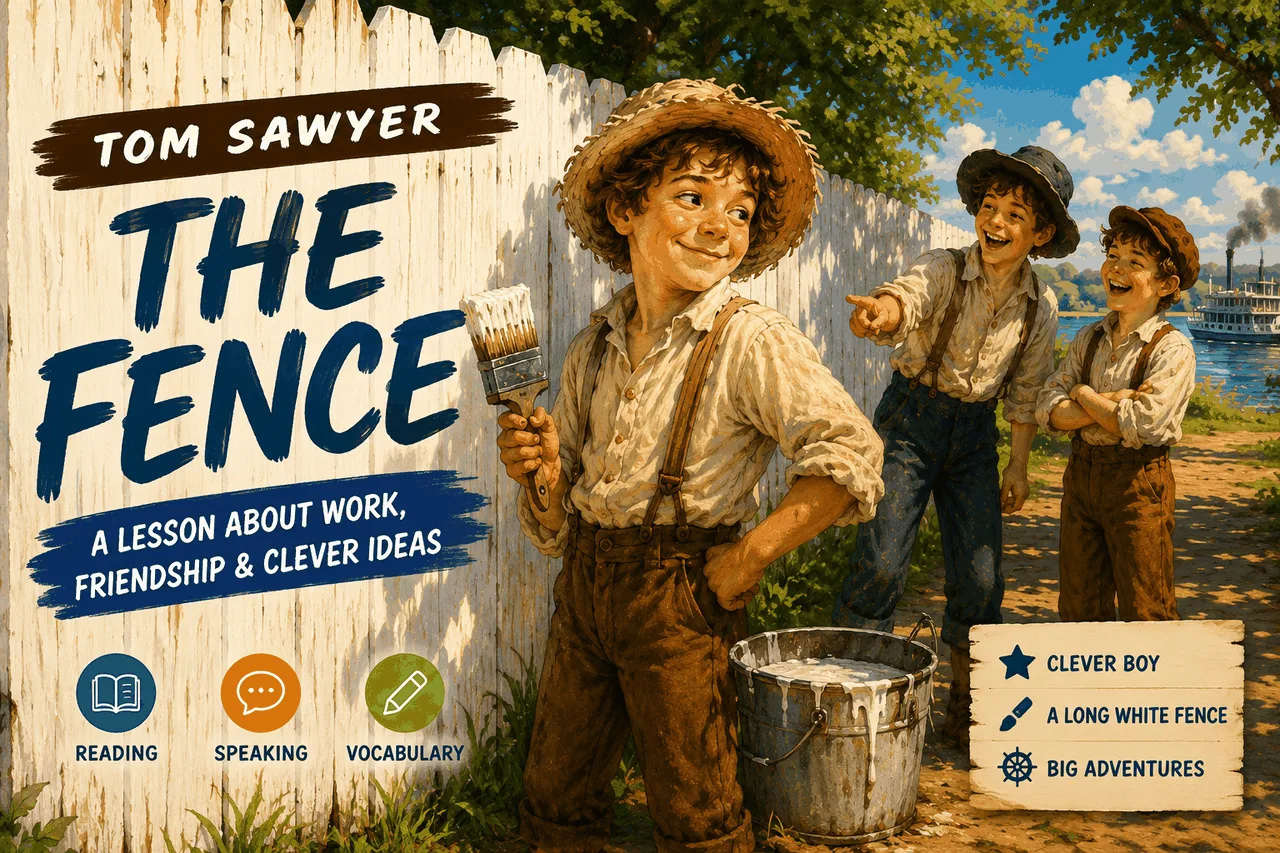
One morning, Tom Sawyer got into trouble again. Aunt Polly was very angry because he did not go to school and spent the day playing. As a punishment, she told him to paint a long wooden fence. It was a hot summer day, and the work looked very boring.
Tom stood in front of the fence and felt unhappy. The fence was very long, and he had to paint it all alone. His friends were outside, laughing and playing. At first, Tom started to work slowly, but soon he had an idea.
When his friend Ben came by, Tom did not look tired. He worked carefully and smiled as if he enjoyed painting.
Ben Rogers was eating an apple and pretending to be a steamboat, making loud noises and laughing.
"Well, Tom," Ben called out, "you have to work today!"Tom did not answer at once. He continued painting, watching the fence with serious attention. Only after a moment did he turn slightly.
"Work?" he said calmly. "You call this work?" Ben stopped. "Well… yes. Isn't it?" Tom shook his head slowly. "Maybe it is for some boys. But not for me.""Do you have to paint the fence?" Ben asked. Tom answered calmly: "No, I don't have to. I want to. It's not every day that a boy gets a chance to paint a fence."
Tom dipped his brush again and painted another careful line. "Aunt Polly is very particular about this fence. It's not just painting. It has to be done right. Very few boys could do it."
Ben looked at the fence, then at the brush, then back at Tom. The idea began to grow in his mind. "Can I try?" he asked.
Tom hesitated. He looked uncertain, even worried. "I don't know… Aunt Polly… she's very strict. If something goes wrong…"
"I'll be careful!" Ben said quickly. "Please, just a little!"Tom thought for a moment, then slowly handed him the brush. Ben gave him his apple at once and started painting with great enthusiasm. Tom sat down in the shade, took a bite of the apple, and watched.
Soon another boy came, then another. Each of them laughed at first — until they saw how seriously the work was done. Then they, too, wanted to try. And each one had to give Tom something in return: a toy, a piece of food, a small treasure.
By midday, Tom was rich. He had marbles, pieces of chalk, a broken knife, a string, and many other small but valuable things — at least in a boy's world. The fence was not only painted, but covered with several layers.
Tom leaned back and smiled. He had done almost no work, yet everything was finished. And more than that — he had learned something. He had discovered that if you make people believe that something is special, they will want it. Even if it is only painting a fence on a hot summer day.
Mark Twain was not just a writer — he was a sharp observer of life. He grew up near the Mississippi River, just like Tom Sawyer, and many of his stories are based on real childhood memories. Twain understood how boys think: their love of freedom, their dislike of rules, and their endless imagination. That is why his stories feel so real and alive. He does not simply describe events — he shows how children see the world.
Tom Sawyer is one of those boys. He is clever, playful, sometimes lazy, and often gets into trouble. After the famous fence episode, his adventures did not stop. He once traded simple objects for Bible tickets at school and even managed to win a prize without really earning it — just by being smart and confident. He and his friends played pirates, ran away from home, and dreamed about treasure.
This story is worth reading because it is not only about fun. It shows how a child grows, makes mistakes, and learns from them. Tom lies, plays tricks, avoids work — but at the same time he is brave, loyal, and capable of real courage. His adventures move from simple games to dangerous situations, where he has to make serious decisions.
Huck Finn was a boy who lived outside the rules. He did not go to school, did not wear clean clothes, and did not listen to adults. He slept where he wanted, ate when he could, and spent his days walking around the town or near the river. Many adults said he was a bad boy, but for Tom he was the most interesting person in the world.
Tom met Huck near the river one evening. Huck was sitting on a wooden barrel, holding a dead cat in his hands. He said it was a special way to cure warts, but it only worked at midnight in a graveyard. Tom immediately became interested.
That same night, they decided to go together. They took the cat and quietly left the town. The streets were empty, the houses were dark, and even the wind sounded different.
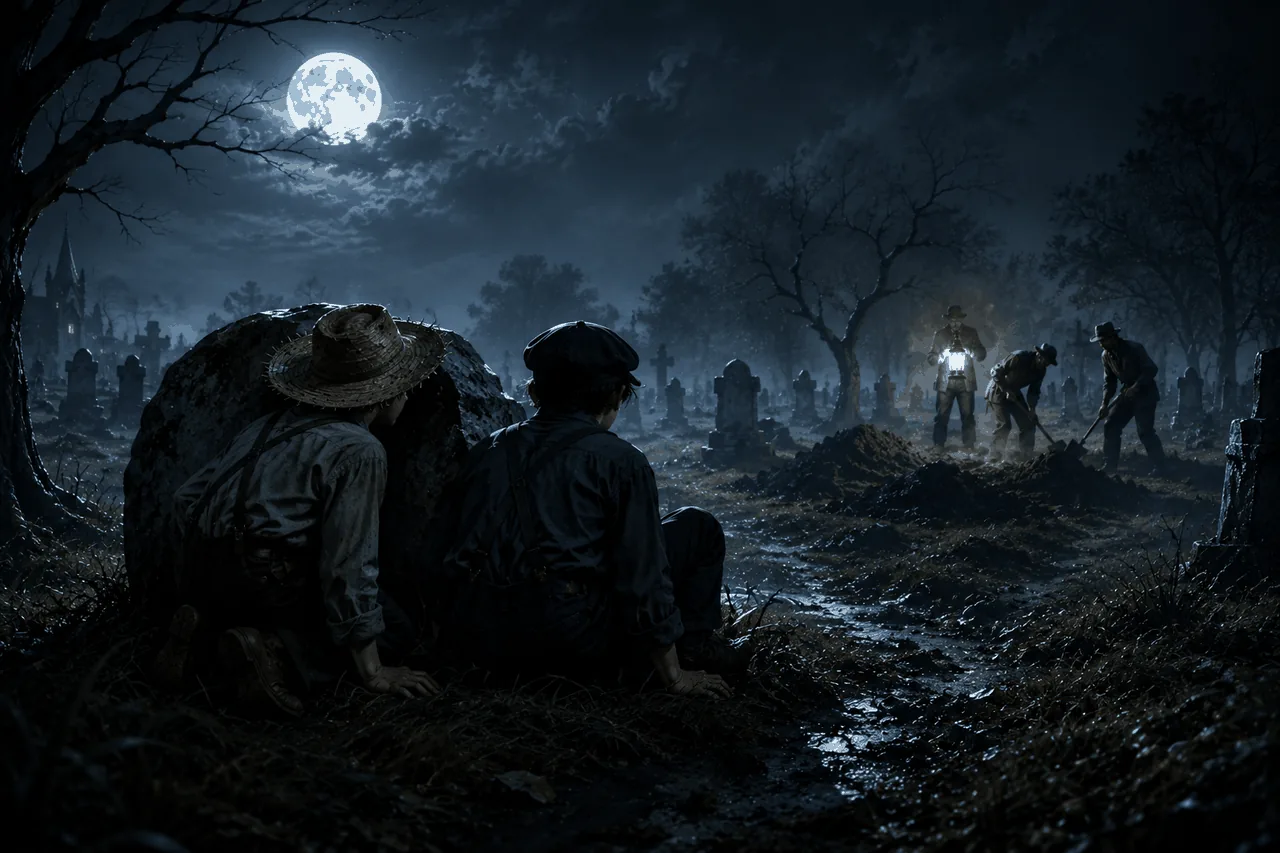
The graveyard stood on a hill, old and silent. The moon was bright, and the shadows of the trees moved slowly on the ground like dark hands. The air felt cold and heavy. Tom and Huck stepped carefully between the graves, trying not to make any noise. Even the smallest sound seemed too loud in that place.
"Huck… do you hear that?" "No… just the wind… I think… let's not talk."They found a fresh grave and quickly hid behind a large stone. Suddenly, they heard footsteps. Three men came into the graveyard. One of them carried a lantern, and its weak yellow light moved across the stones.
"What are they doing?" "Grave robbers… it must be…"At first, Tom thought they were just robbers. But then something changed. The men stopped digging and began to argue.
"You promised me more money." "I did my part. That's enough." "Enough? After everything I did?"Their voices grew louder. The night was no longer quiet. The shadows moved quickly. Tom felt his breath stop. Then, without warning, one man attacked another. The lantern fell to the ground. There were heavy sounds, sharp movements, and a terrible cry.
A man was killed.
Everything became silent again, but the silence was different now. It was not calm. It was empty. Tom and Huck did not move. They were frozen with fear.
"Huck… is he… dead?" "Don't look… don't look…"They knew they had seen something they were never supposed to see. Their adventure had turned into something real, something dangerous.
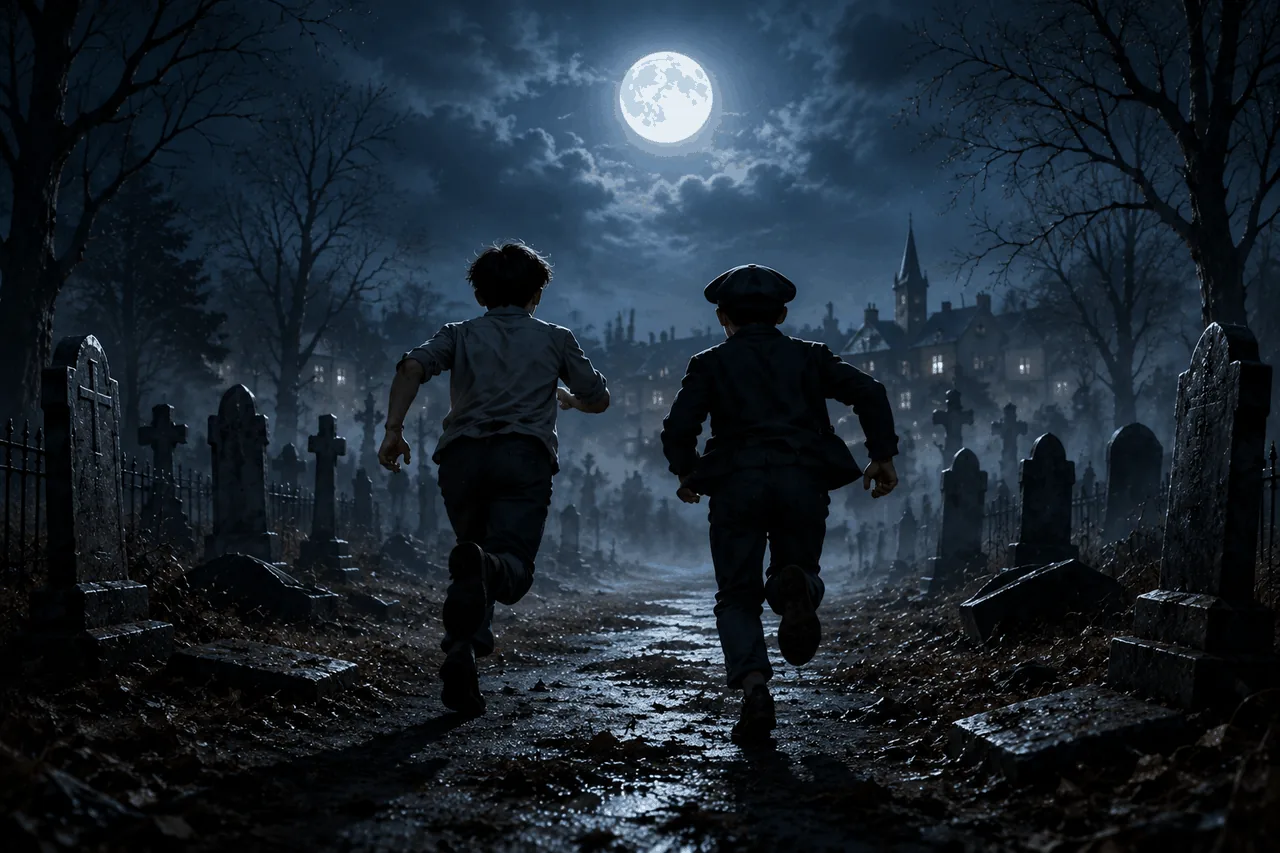
When the boys finally ran away, they did not stop for a long time. They ran past the trees, past the hill, back toward the sleeping town. Their feet hit the ground quickly, their breath was loud, and their hearts were still racing. Only when they were far away did they slow down.
"We must tell someone…" "Are you crazy? No… we can't…" "But a man is dead… we saw everything…" "And if we tell… they will know it was us…"Tom looked down at his hands. They were shaking. He tried to speak again, but his voice was quieter now.
"It's wrong to stay silent…" "It's worse to be dead…"They stood in silence. The night around them was quiet, but now it felt heavy, like it was pressing down on them. For the first time, it was not a game anymore. It was a choice.
"Promise me… we don't tell anyone." "I promise… if you promise too…" "I promise."They looked at each other and nodded. They made a promise: they would never tell anyone what they had seen. But the secret did not bring them peace. At night, they could not sleep. Every sound felt dangerous. Every shadow looked alive. The secret stayed with them. And it only made everything heavier.
The truth protects innocent people. A secret is heavier than a punishment. Tom and Huck would never be free until they spoke.
The men are dangerous. If the boys speak, they put their own lives at risk. Sometimes silence is wisdom, not cowardice.
You want to tell the truth. Explain to your partner why. Use phrases like "I can't keep this inside…" / "A man is dead because of us…"
You are afraid. You believe silence is safer. Convince your partner. Use phrases like "They will come for us…" / "Nobody will believe two boys…"
Together: explore the possible outcomes of each decision.
After the night at the graveyard, Tom and Huck carried the secret like a stone in their pockets. They could not sleep well, and even daylight seemed darker than before. Mark Twain shows us how a child slowly learns that the world is not always a game.
But Tom was still Tom. He still wanted attention. He still believed he could trick the world. And just a few days later, he tried again — this time in a place where you cannot trick: in church, in front of everyone, with a question waiting for a real answer.
Click one word on the left, then its match on the right. Correct pair locks green. Wrong pair shakes red — try again.
Read each statement and guess if it is true or false. Don't worry — you can't be wrong here. After you read the story, come back and check.
Sunday morning came, and the small town of St. Petersburg woke up slowly. The church bells rang across the river, and families walked toward the white wooden church on the hill. Inside, the Sunday school children sat in tidy rows, waiting for class to begin.
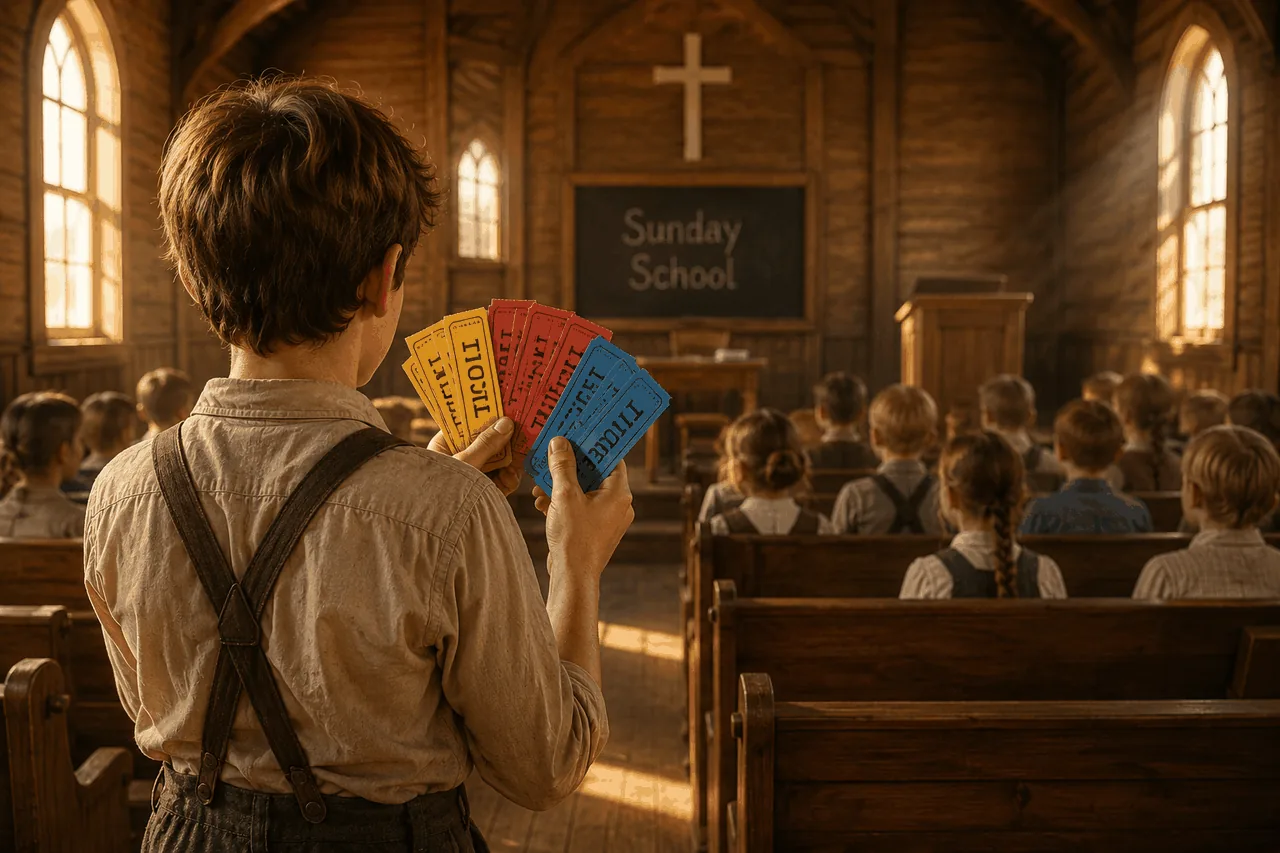
For most boys, Sunday school was a boring duty. They had to memorize Bible verses during the week, and on Sunday they had to recite them in front of the teacher. Each verse remembered correctly gave a yellow ticket. Ten yellow tickets could be exchanged for one red ticket. Ten red tickets gave one blue ticket. And ten blue tickets — at last — gave the great prize: a real Bible with a picture on the cover.
Most boys could not collect that many tickets. The work was too hard, and the verses were too long. But Tom Sawyer wanted that Bible. Not because he believed in learning, but because he wanted everyone to look at him.
Tom had spent the week trading. After the fence trick, his pockets were full of small treasures: marbles, fish-hooks, a piece of blue glass, a top, a dead beetle in a box. On Sunday morning, just before church, he stood near the school gate and quietly traded each treasure for tickets. By the time class began, his hand was full of bright pieces of paper — yellow, red, and finally blue.
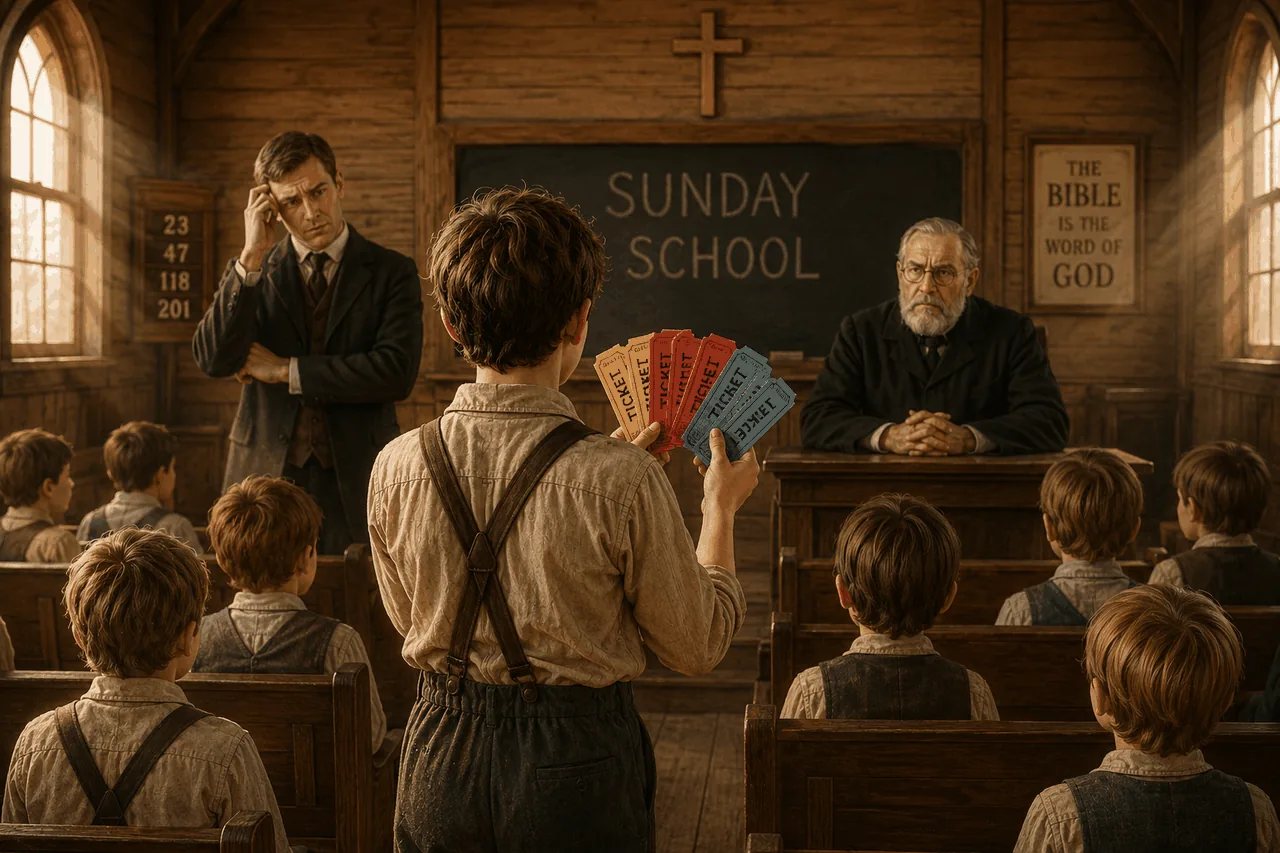
When Mr. Walters, the superintendent, asked who was ready to claim the Bible, no one stood up. Then, slowly, Tom raised his hand. The whole class turned in surprise.
"Tom Sawyer?" Mr. Walters said, almost laughing. "Are you sure?"Tom counted out his tickets — nine yellow, several red, and exactly the right number of blue. The room went silent. Mr. Walters was confused but proud. There was an important visitor that morning — Judge Thatcher, the father of a girl named Becky. The Judge had to see this. A boy who had worked so hard for the holy book! What an example to the others!
Tom walked up to the front, his heart shaking, the tickets shining in his hand. The Judge smiled. "A fine boy. A fine boy. And so young, too." He shook Tom's hand. "Tell me, my son — could you name the first two of the twelve disciples?"
Tom's mouth went dry. He had not memorized a single verse. He did not know the disciples. He did not even know what a disciple was. But the room was waiting. The Judge was waiting. Becky was watching from the second row.
So Tom did the only thing he could. He opened his mouth, and — too loud — he said:
"DAVID AND GOLIATH!"
The room froze. Mr. Walters dropped the Bible. The Judge stared. The other boys began to laugh.
Tom did not get the prize that day. He got something worse: he had shown himself to be a fraud, exactly when he most wanted to be admired.
He walked home slowly, the laughter still ringing in his ears. And for the first time in a long time, he understood something. You can trick people for a while. But you cannot trick a question.
Tom took a real chance. Most people stay quiet and safe. He had the courage to try. That is the start of every successful person.
Cleverness without real knowledge is a public failure waiting to happen. The first hard question — and the whole trick falls apart in front of everyone.
You are walking home alone, the laughter still in your ears. You meet Becky on the path. What do you say? Defend yourself? Apologize? Make a joke? Use phrases like "I was just trying to…" / "It wasn't what it looked like…"
You saw everything. You feel sorry for him, but also disappointed. What do you say? Are you honest, or kind? Use phrases like "I saw what happened…" / "You don't have to pretend with me…"
Together: try the same scene twice. First — Becky is gentle. Second — Becky is honest. Compare.
Click one word on the left, then its match on the right. Correct pair locks green. Wrong pair shakes red — try again.
Read each statement and guess. You can't be wrong here. After you read the story, come back and check.
Monday morning came too quickly. After the embarrassment of Sunday school, Tom walked to class with his head down. David and Goliath. The boys would not forget that for a year. He kicked stones along the dusty road and tried to make himself invisible.
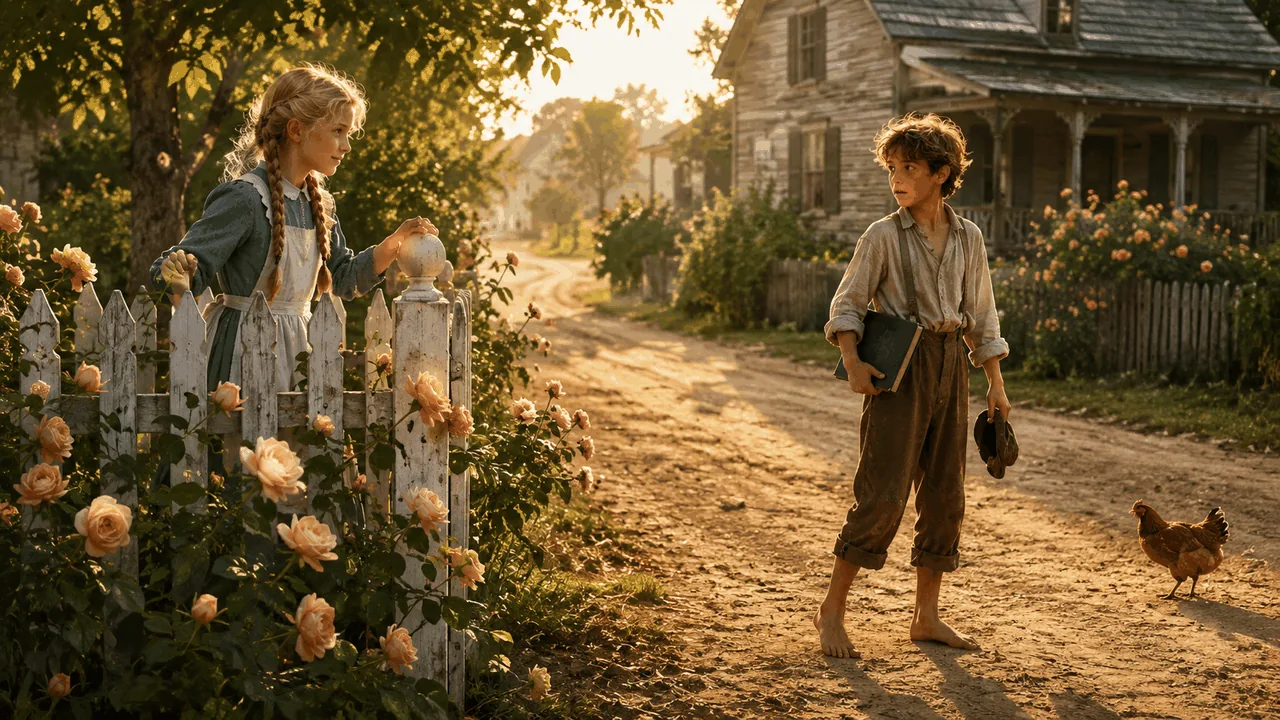
Then, at the corner of a white wooden fence, he stopped. A new family had moved into the house with the peach roses, and a girl was standing in the front garden, looking at him. She had bright yellow hair in two long braids, and a clean blue dress, and eyes that were not afraid of his eyes. Tom had never seen anything like her in all his life.
In one second, Sunday school disappeared. David and Goliath disappeared. The world had only one shape now, and it was the shape of her.
He did the only thing he could think of — he began to show off. He walked past her on his hands. He jumped over the fence and back again. He threw his cap on the roof of the house. He pretended to fight an invisible enemy in the road. He fell to the ground and pretended to be dead. She did not look — or she pretended not to look — but the corner of her mouth was smiling.
When the school bell rang, she walked toward the gate. As she passed him, she dropped a tiny purple flower onto the path and walked on without turning her head. Tom picked up the flower and hid it inside his shirt, against his heart.
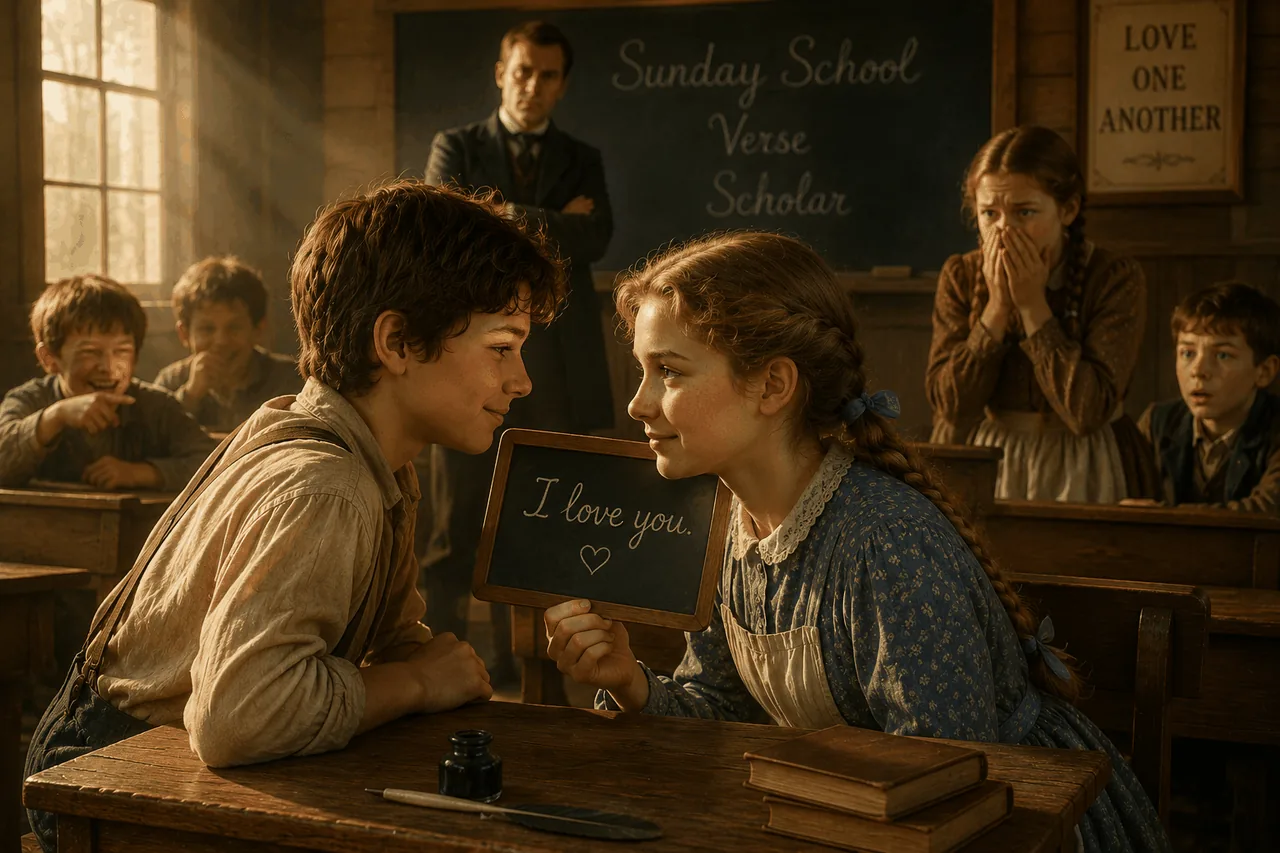
In the classroom, he sat at the desk behind hers. He could see her braids. He could not breathe. He took out his small black slate and a piece of chalk. He wrote, in big shaky letters, I LOVE YOU. Then he held the slate up over her shoulder so she could see it.
Becky did not turn around. But her ears went pink, and Tom saw the smile reach the corner of her cheek. He had won.
After the last lesson, the other children ran out into the sun. Tom and Becky stayed behind. They sat together in the empty classroom, and Tom gave her half of his piece of chewing gum. They chewed in silence, the way grown-ups drink coffee together — slowly, importantly. He was not Tom Sawyer the boy now. He was Tom Sawyer the man.
"Becky," he whispered, "let's be engaged. You say you love me. I say I love you. Then we kiss. And after that we always sit together at lunch, and we always choose each other in the games, and you never look at any other boy."
"And… we kiss?" she said, very quietly.
"We kiss." He closed his eyes. She kissed him on the cheek — quick, light, like a butterfly. Tom thought his chest would explode.
He could not stop talking. He was too happy. He wanted to brag. "Oh, Becky, it's so much nicer than I thought! It's nicer than when I was engaged with Amy Lawrence."
The room went silent. Becky's eyes opened wide.
"Amy Lawrence?" she said. "You were engaged… before?"
"I — I — no — yes — but I don't love her now! Only you! I forgot her completely! I —"
Becky began to cry. Quiet, real tears. Tom panicked. He searched his pockets and pulled out his most precious thing — a small brass knob he had taken from the old fireplace. He had carried it for two months. It was his treasure. "Becky, please — take it, it's the best thing I have —"
She slapped the knob from his hand. It rolled across the wooden floor with a sad, hollow sound. Then she ran out of the school, her braids flying behind her, and did not look back.
Tom picked up the brass knob. He looked at it. He put it in his pocket again. He did not go home. He walked into the small wood behind the schoolhouse, sat down on a log, and stayed there until the sun went down.
And he learned the second hard thing of that week. The first was Sunday — that you cannot trick a real question. The second was Monday — that the same heart that wakes up in love at breakfast can be broken by lunchtime. Both times, the trouble had been the same: he had spoken when silence would have saved him.
Children love with the whole heart, without calculation. Tom forgets everything in one second. Adults learn to protect themselves — and lose half of what they could feel.
Tom is "engaged" twice in the same school year. Becky cries about a name. They don't know themselves yet. Real love needs time and trust — two things twelve-year-olds don't have.
You did not sleep. You walk into the schoolyard early. Becky is already there with her friends. You need to say something. Use phrases like "Becky, can I talk to you for a minute?" / "I didn't mean what I said about…" / "You're the only one I…"
You also did not sleep. Part of you wants to forgive him. Part of you is still angry. Choose one and stay with it. Use phrases like "How could you say that?" / "I need to think about it." / "You don't get to decide when I forgive you."
Together: try the same conversation twice. First — Becky forgives. Second — Becky doesn't. Compare how Tom changes.
Click one word on the left, then its match on the right. Correct pair locks green. Wrong pair shakes red — try again.
Read each statement and guess. You can't be wrong here. After you read the story, come back and check.
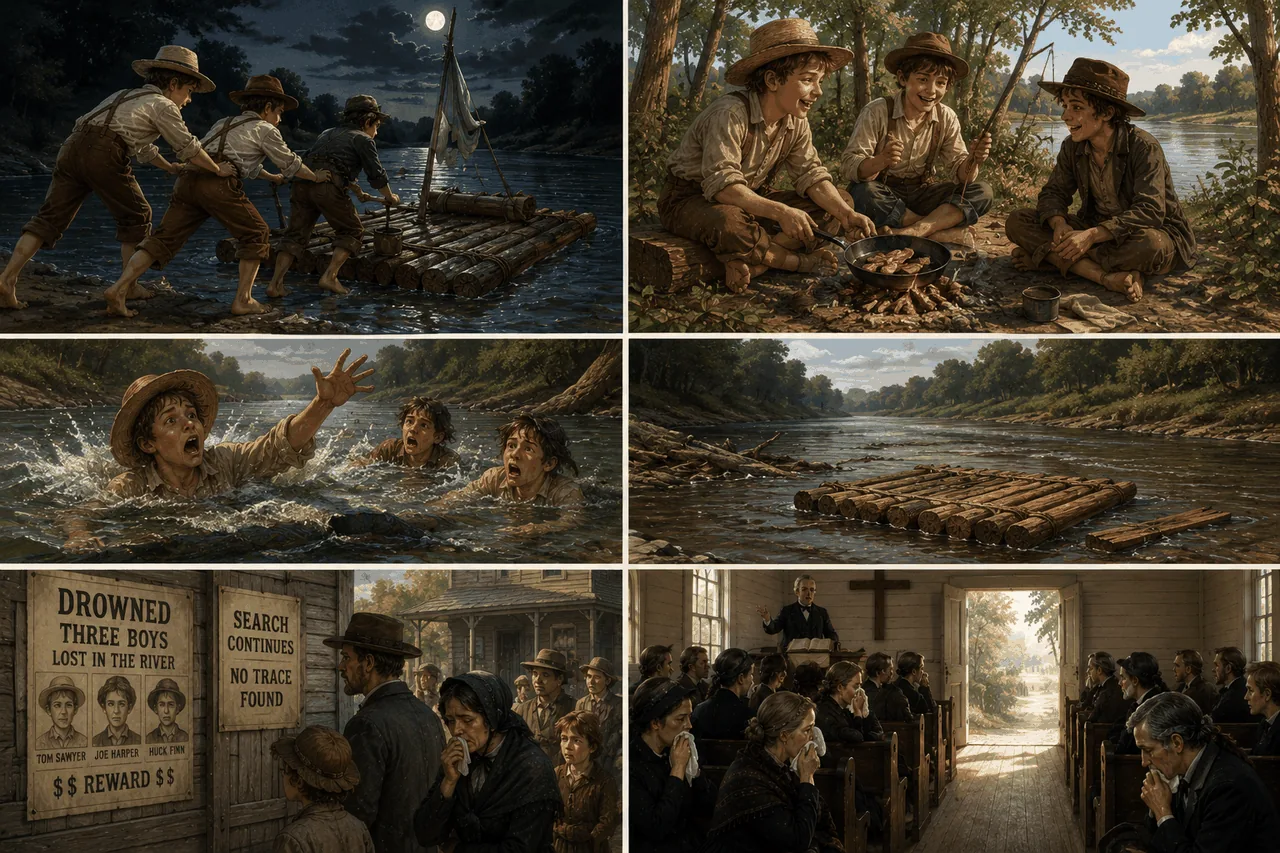
After the night at the graveyard, the secret was too heavy to carry. Tom did not sleep well, and even his old games stopped working. So when Joe Harper came one afternoon with the same unhappy face — punished at home, tired of being a child watched all day — Tom and Joe and Huck made a plan together. They would run away. They would become pirates.
That night, in the dark, they pushed a small wooden raft into the wide Mississippi and floated down to Jackson's Island, three miles below the town. The island was thick with trees, full of birds and frogs. They had bacon, a fishing line, and a stolen frying pan. For two days it felt like freedom.
But on the third day, something began to bother Tom. Not hunger — something quieter. He kept thinking about Aunt Polly. About her face when she would hear the news. About the empty chair at supper. About the bed she had made for him that morning, expecting him.
One night, when Joe and Huck were asleep around the fire, Tom slipped away. He found a log, paddled across the dark water, and walked silently through the village to his own house. The window was open. Aunt Polly was sitting at the table, Sid beside her, the candle low. She was talking, half to him, half to herself.
One night, when Joe and Huck were asleep around the fire, Tom slipped away. He found a log, paddled across the dark water, and walked silently through the village to his own house. The window was open. Aunt Polly was sitting at the table, Sid beside her, the candle low. She was talking, half to him, half to herself.
"He warn't bad, you know — only mischievous. Only thoughtless… and the kindest boy that ever was."And then she put her face in her hands and cried. Tom stood frozen in the dark grass, listening. He had never heard anyone cry like that before. It was not the cry of someone angry. It was the cry of someone who had loved him all along — and only now, when she believed she had lost him, could she say it out loud.
For a long minute, Tom almost ran inside to say "I'm here, aunty, I'm not dead." But something stopped him. A different idea — a terrible, beautiful idea — was forming in his head. He turned and slipped back through the grass to the river.
Back on the island, he told Joe and Huck what he had seen — and what they would do.
The town believed the three boys had drowned. The men had searched the river for days. They had found pieces of the raft. They had stopped looking. The funeral was set for Sunday morning.
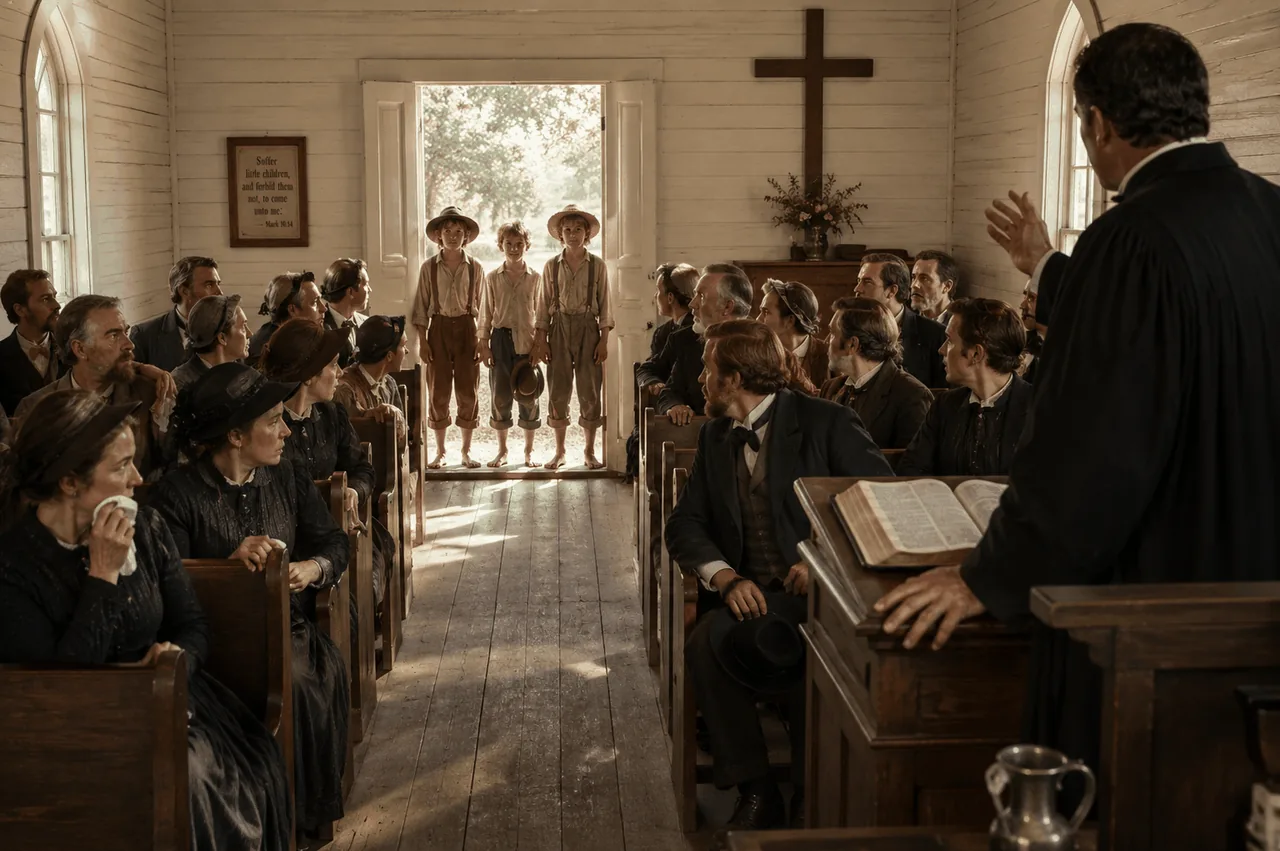
On Sunday the small white church was full. Every villager came. Aunt Polly sat in the front pew, her face grey, holding Sid's hand. Mrs. Harper sat beside her, holding nothing. The minister climbed into the pulpit and began the sermon. He spoke softly about the three boys. He said things about them that no one had ever said while they were alive — that they were good, that they were promising, that they were missed. The women cried. The men looked at the floor.
And then — exactly at the moment when the church bell tolled for the final time — the big back doors of the church creaked open. Sunlight poured into the centre aisle. The minister looked up. The congregation turned.
In the open doorway stood three small barefoot figures: Tom Sawyer, Joe Harper, and behind them, half-hidden, Huckleberry Finn. River mud was still on their clothes. They had walked up the aisle of their own funeral.
For one second there was no sound at all. Then a wave of crying and laughing and shouting rose at once. Aunt Polly seized Tom and held him so tight he could not breathe. Mrs. Harper kissed Joe. People reached out to touch Huck — even Huck, who had never been touched before. The minister gave up the sermon and began the old hymn "Old Hundredth", and the whole congregation sang it as loud as they had ever sung anything in their lives.
Tom stood there in his aunt's arms, the song shaking the wooden walls of the church. He had got what he came for. Every eye in the town was on him. Every heart was open to him. He had walked back from the dead, in front of everyone, and he was a king for one perfect morning.
But late that night, lying in his own bed — the bed Aunt Polly had kept made for him — Tom remembered the sound of her crying through the window. And he understood, for the first time, that the price of his glorious return had been her three days of real grief. He had let her break her own heart to make his entrance more beautiful.
That was the day Tom Sawyer learned that some shows cost more than the audience can see.
It is one of the most memorable scenes in American literature. Tom turned grief into joy. Every face in the church was lifted in one second. That kind of theatre is rare — and beautiful.
The price of his perfect entrance was three days of real grief for his aunt and the Harpers. He stood in the dark grass and chose his own show over her tears. That is not bravery — that is using people.
The whole village has gone home. The candle is low. Aunt Polly is sitting at the table, not looking at you. You know she knows you heard her cry. What do you say? Try to be honest. Use phrases like "Aunty, I heard you that night…" / "I should have come in. I didn't because…"
You are relieved, you are grateful, and you are also a little broken. You loved him through three days of believing him dead. You don't want to punish him — but you don't want to pretend it didn't hurt either. Use phrases like "I am glad you came back. But…" / "You don't know what those three days were like…"
Together: try the scene twice. First — gentle. Second — honest. Compare which version feels truer.
Click one word on the left, then its match on the right. Correct pair locks green. Wrong pair shakes red — try again.
Read each statement and guess. You can't be wrong here. After you read the story, come back and check.
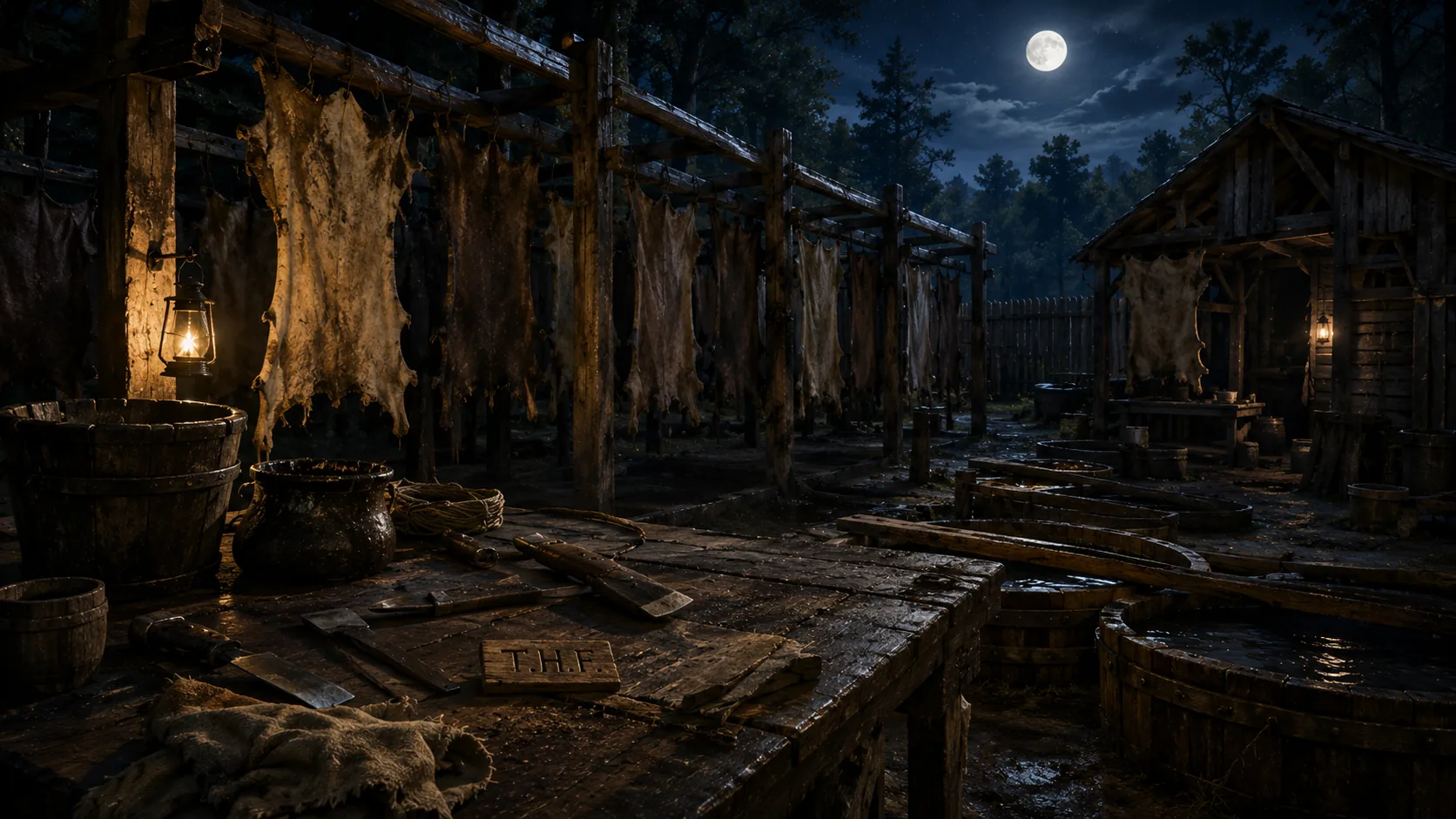
After the terrible night at the graveyard, Tom and Huck ran until they reached an old tan-yard on the edge of town. They both knew one thing: nobody must ever find out what they had seen. Tom took a pin and cut both their thumbs. In their own blood, they wrote a short, terrible oath on a piece of wood: "Tom Sawyer and Huck Finn swears they will keep mum about this — and they wish they may drop down dead in their tracks if they ever tell." They buried the wood under a tree. The secret was locked.
But the secret would not let them sleep. Tom had bad dreams every night and talked in his sleep. Huck was pale and quiet. Every knock on the door made them jump.
Meanwhile, the town of St. Petersburg was in shock. Muff Potter, a poor drunk man, was arrested for the murder. Everyone believed he had done it — because Injun Joe, the real killer, had lied and put all the blame on Muff. Muff himself did not remember anything from that night. He sat in the town jail, confused and afraid, waiting for the trial. The whole town said the same word: "guilty."
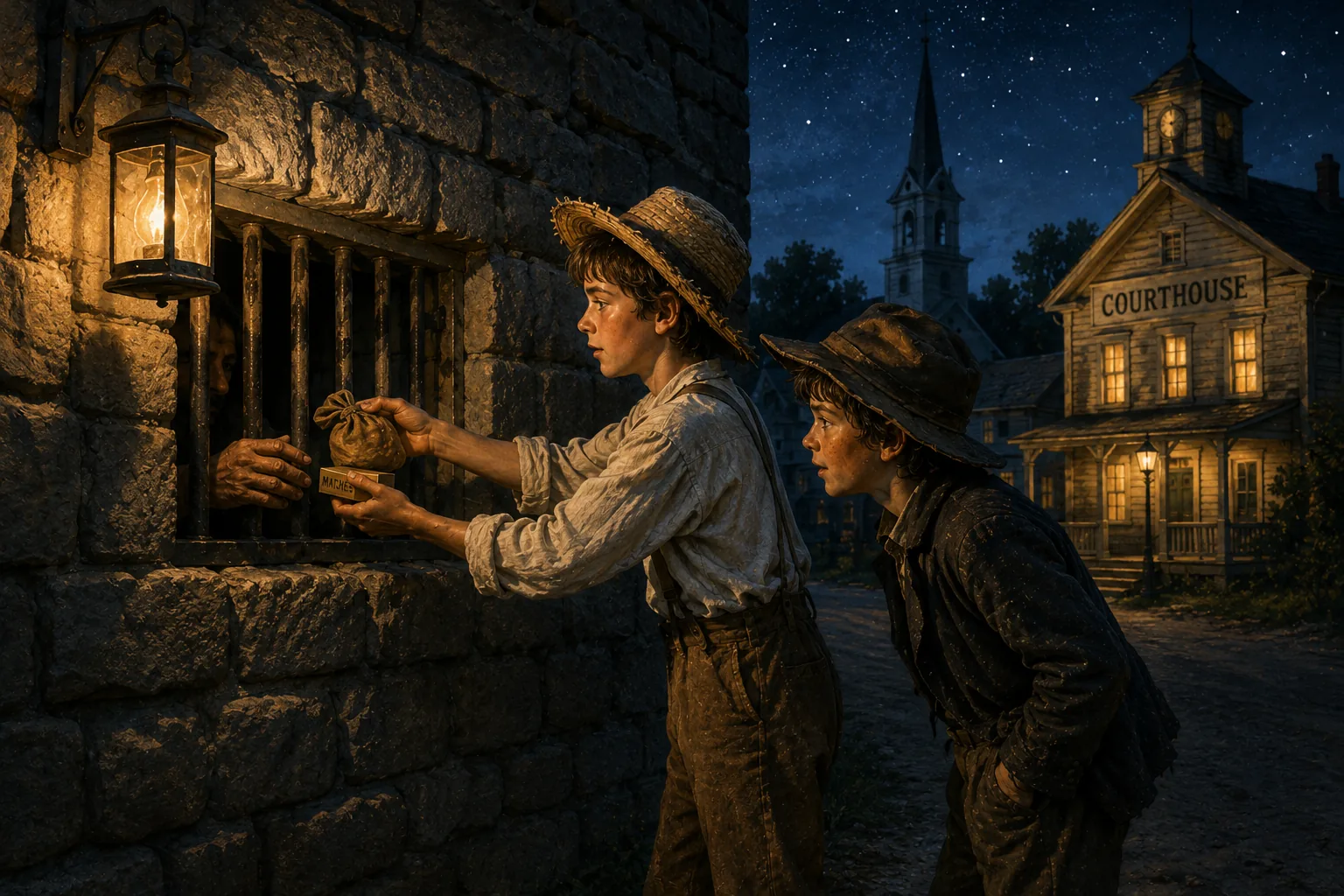
Only Tom and Huck knew the truth. Only they knew Muff was innocent. At night, they would sneak up to the small jail window and pass tobacco and matches through the bars. Muff always thanked them and cried a little. Every time they left, the guilt grew heavier.
Then the trial began. The whole town squeezed into the small courtroom. Injun Joe sat calm and cold, telling his lie again. Muff Potter looked like a man already dead. Tom sat in the crowd, his heart pounding. He looked at Muff. And then — before he could stop himself — Tom stood up. He walked to the front. He became a witness. He told the courtroom what he had really seen.
The room went silent. Then Injun Joe jumped up like a wild animal, threw himself at the window, and escaped into the night. Muff Potter was free. The town called Tom a hero. But Tom did not feel like a hero. For weeks after, every time he heard a branch move outside his window, he thought: Injun Joe is out there. And he remembers who spoke.
An innocent man was about to die. Muff Potter had no one but two small boys who knew the truth. A promise to protect a lie is a bad promise. Tom did the only right thing — even though it cost him his sleep.
Tom signed his name in his own blood. He made the promise freely. Now he lives with a killer looking for him. Once you break one promise, the next one is easier to break. That is how a boy loses his own word.
It is late. You have pushed tobacco and matches through the bars again. Muff is thanking you. Every "thank you" feels like a stone on your chest. You know something he does not know. What do you say? What do you keep silent about? Use phrases like "You don't have to thank us…" / "There's something I can't tell you yet…"
You are alone. Two barefoot boys keep coming at night. You don't understand why they care. You do not remember what happened. But something in their faces tells you they know more than they are saying. What do you ask them? What do you say to them? Use phrases like "Boys, why do you keep coming?" / "You look at me like you know something…"
Together: try the scene twice. First — the boys keep the secret. Second — one of them almost tells. Compare which version feels harder.
Click one word on the left, then its match on the right. Correct pair locks green. Wrong pair shakes red — try again.
Read each statement and guess. You can't be wrong here. After you read the story, come back and check.

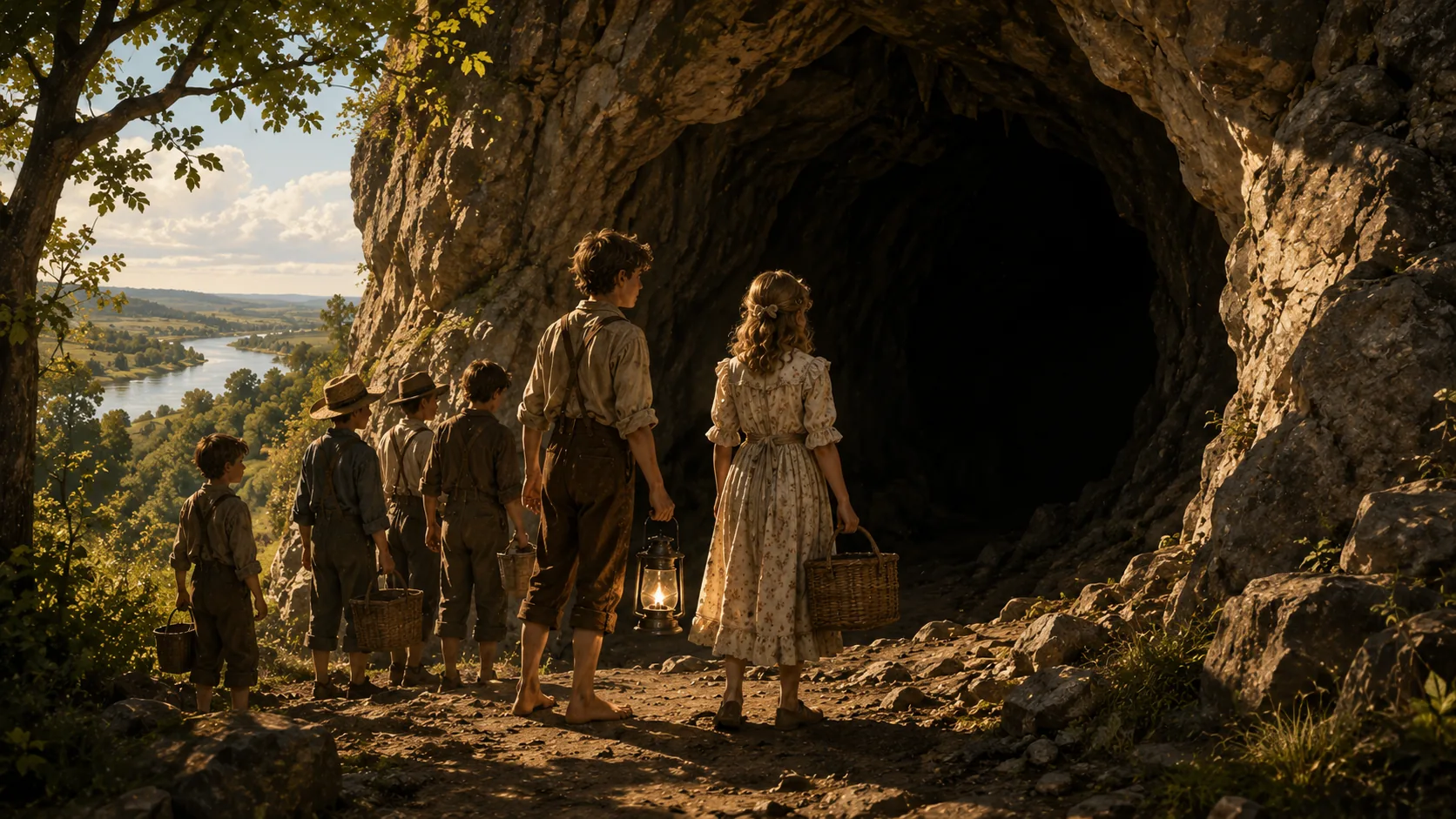
That summer the whole village went on a picnic to McDougal's Cave. The children lit their small pine torches at the wide stone mouth, laughed, and ran into the first great hall. Tom held Becky's hand. He wanted to show her something no one else had seen. Deep in the cave there were narrow tunnels that split like the branches of a tree.
They followed one turn. Then another. Then a third. Every wall looked the same — grey, wet, silent. Behind them the voices of the other children became a whisper, then nothing. Becky's candle shook in her hand. "Tom," she whispered, "I think we are lost."
Tom did not answer for a moment. He held both candles up and counted: two flames, maybe three hours of light. That was all. "It's all right, Becky," he said, and he made his voice calm. "We just have to be quiet and listen." They called out. Nobody answered. The tunnels swallowed every sound. After a long time Becky was too tired to walk. She sat down on a stone and cried. Tom sat beside her and gave her the last piece of cake he had kept in his pocket. He did not eat any himself.
Then his own candle went out. In the black silence, Tom heard something worse than silence — quiet footsteps. Far away, a small cold light. And in that light, a face he knew: Injun Joe, the man who had escaped at the trial. He was hiding here, deep in the cave. Tom pressed his back to the wall and did not breathe. Injun Joe passed and did not see them. Tom did not tell Becky. She could not carry this on top of everything else.
He took a long piece of kite string from his pocket and tied one end to a rock beside her. "I'll go a little way and explore," he said. "Hold the string. If it goes tight, pull me back." He crawled into a new tunnel, then another, and another. Every time he came back to Becky. Every time she was still there. On the third time, at the end of a long dark passage, he saw something impossible: a small hole of pale grey daylight. He crawled to it. Below him, a river, and beyond it, the flat green fields near their village. Three days lost. He came back for Becky.
The villagers found them at the far side of the hill, dirty, thin, exhausted, holding each other's hands. Judge Thatcher hugged Becky and cried. Aunt Polly hugged Tom for a long time and did not scold him even once. A few weeks later, the villagers put a heavy iron door on the mouth of the cave. Only Tom knew that behind that door, in the dark, someone was still walking.
Becky was already exhausted, hungry, and terrified. Adding a killer to that could have broken her completely. Tom carried the weight of two people for three days. That is what love actually looks like when no one is watching.
A partner in danger has the right to see the danger. Tom decided for her, again — like at the fence, like at the funeral. Kindness that hides the truth is still a kind of show. The person you love is not a smaller person than you.
Both candles are gone. You have just seen Injun Joe pass by. You cannot tell Becky. You are about to crawl into another tunnel with the string in your hand. What do you say to her before you go? What do you promise? Use phrases like "Becky, look at me. I need you to…" / "I'll be back. I promise. If the string goes tight…"
You are exhausted. You have been crying. You do not want him to leave you alone in the dark, even for a minute. But you also know one of you has to try. What do you ask him? What do you say to him before he crawls away? Use phrases like "Please don't go far…" / "If you don't come back, I…" / "Tom, tell me the truth — are you scared too?"
Together: try the scene twice. First — Tom lies about being scared. Second — Tom tells the truth. Compare which one holds them closer.
At the fence, he wins by reading other people.
In the graveyard, he learns that some games are real.
At Sunday school, he discovers the one thing he cannot trick — a question with a real answer.
With Becky, he learns that the same heart can win and lose between breakfast and lunch.
At his own funeral, he learns that some shows cost more than the audience can see.
At the trial, he learns that the truth breaks a promise — and costs him his sleep.
In the cave, he learns that being brave is holding another hand when your own candle goes out.
— Mark Twain · 1876 · adapted ·