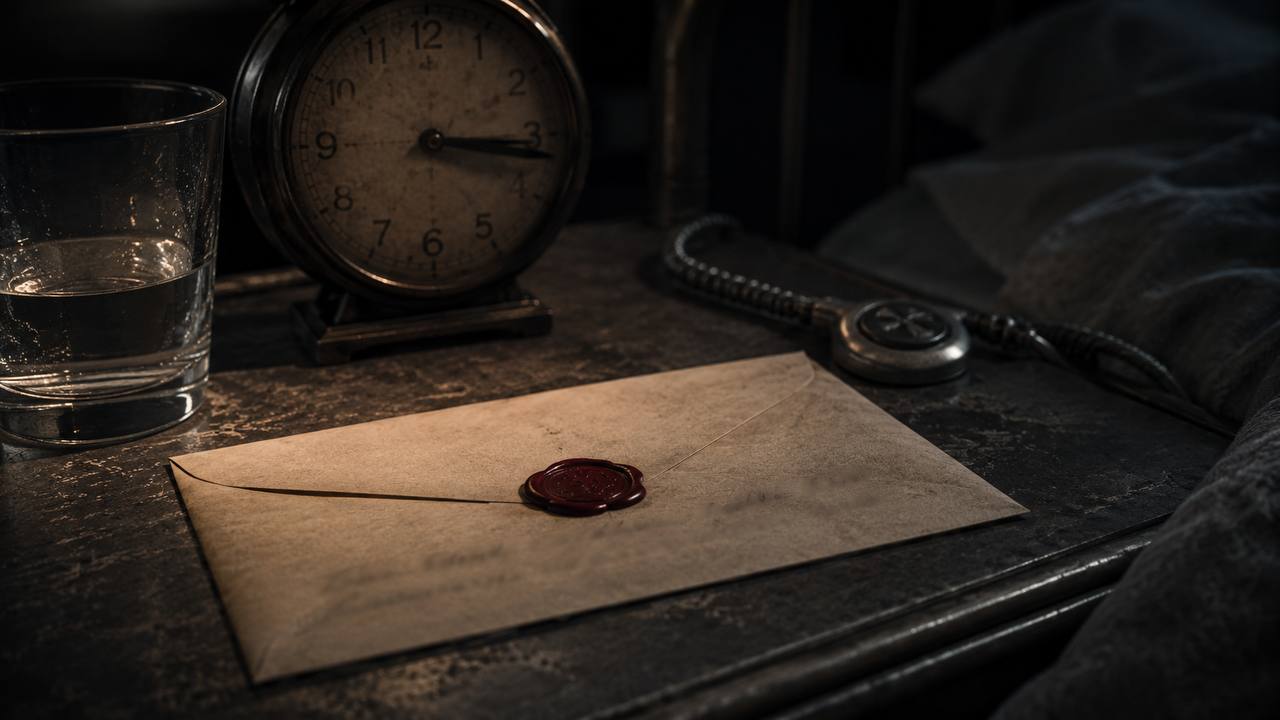
Forty-one days after Dr Reyes went public, an envelope is hand-delivered to Theo Marshall's bedside. It is the letter you finished writing at the end of Lesson 3. Theo reads it three times. Around three in the morning, he understands he is not alone in the room — and the person sitting in the visitor's chair has been there since Lesson 1.
↩ L1 echo · the watchmaker↩ L2 echo · Proxima signal↩ L3 echo · Naomi's letter
Level
B2 / B2+
Duration
~60 minutes
Grammar
Reported speech · Perfect modals · Inversion
Story arc
Episode 4 of 4 · finale
Previously in the series
L1 · Watchmaker (1995). An old clockmaker fixes a watch for a stranger, Theo Marshall. His granddaughter Mia is at his elbow. That night he writes one line about the visitor: "Mind is still wound."
L2 · Are we alone? Twenty years on, Mia sits at SETI Atacama; her senior, Dr Naomi Reyes, reads a broadcast from Proxima that repeats the clockmaker's rhythm.
L3 · Whose mind? Naomi has left SETI for neurology. Her locked-in patient blinks the watchmaker's line, letter by letter, for eleven weeks — and Naomi realises, in silence, that the man in the bed is her own father.
Now · L4 · The night the letter arrived. Day forty-two after Naomi finally goes public. An envelope is placed by Theo's bed. At three-seventeen in the morning, he blinks a single word — FATHER — and every clock, signal, and page in the series stops on the same beat.
01
Warm-up · what the envelope already knows
Last episode you wrote a letter — Dr Reyes' first message to her team after she confirmed Theo's signal. Tonight that letter ends up on Theo's bedside table. He reads it three times. This lesson is what happens between the third reading and morning.
L1 → L4 echo
Recap from L1: the watchmaker's logbook in Lesson 1 ended with a name written for a date that hadn't happened yet. That name is the same name on the envelope Theo opens tonight — written, again, before it should have been possible.
Before we open the envelope
Answer these out loud (30 seconds each — no perfect grammar):
What is one letter you have never sent — and would never send — and why does that letter still exist somewhere in your head?
If you knew you had only one chance to reply to a message — out loud, on record, in front of strangers — what would you make sure you didn't say?
"I should have told you years ago." Whose voice do you hear saying that sentence first? Yours, or someone else's?
Teacher prep notes
Q1 — listen for any perfect modal slipping in («I would have…», «I could have…»). Mark it; comes back in Section 7.
Q2 — note hedging language («I wouldn't want to», «I'd be careful not to»). This is reported-speech runway.
Q3 — sets up the final reveal. Whatever Ivan answers, return to it in Section 8 («Whose voice did you hear?»).
02
Vocab · 14 words for the letter and the night
School-level B1+/B2 vocabulary — olympiad-friendly, not C1-abstract. Every word comes back in reading, UoE and the speak mission.
Teacher prep notes
All 14 words are B1+/B2 — school olympiad range. They come back in reading, UoE and the speak mission.
to hide — drill irregular forms: hide / hid / hidden. Feeds reported speech in Section 7.
to admit / to forgive / apology — three keys of the lesson's moral arc. On the olympiad Speaking the student will pull them into one sentence.
03
Reading · The night the letter arrived
Reyes Lab · field journal · 23 April · 03:17
The night nurse had left at midnight. The envelope on Theo's bedside table had not moved since. It was addressed in his own handwriting — but he had never owned a pen since the stroke, and no one in the building had seen him form a letter in three years. The address read, in slow careful capitals: To the visitor in chair 2 — by hand.
I unsealed it for him, because he could not. The paper inside was the letter Dr Reyes had drafted for her team at the end of last week — the one she had asked us to copy and send to anyone who had ever doubted her. He had heard it read aloud once already, on Tuesday. Tonight he wanted, I think, to write it down himself, blink by blink, in a way that made him the author and not the witness.
I read the letter to him a third time. I had been told, by Dr Reyes, that he had nothing left to hide — that he had said everything he could say in eleven weeks of three short bursts and two long ones. I had been told to expect an admission, not surprise.
"Not once in three years had he opened his eyes wider than a normal blink. Tonight, halfway through paragraph two, he opened them as if he were trying to see who I was."
— Dr Reyes, that night, on the tape
Halfway through paragraph two, he blinked six letters at me, one at a time. F · A · T · H · E · R.
I am thirty-one years old. I have been Dr Naomi Reyes for the last nine of those years. The other twenty-two I was Naomi Marshall. My father walked out of our house in March of 1995 — the same March that, exactly twenty-eight years later, would take his body and leave him here. I had not told Theo I had found him. I had not told the lab he was my father. I had hidden the truth from my own case, and now my own patient was telling me he had known the whole time.
The clock on the wall — the round brass one that had hung over his bed since he arrived, that I had never asked about — read 03:17. Forty-one days after I had gone public with his signal. Twenty-eight years and one month after the night he had left. I looked at it and remembered, only then, that it was the same clock my mother had owned. I had been reading the timeline from the front of the case. He had been winding it from the back.
I sat down in chair 2.
Q · True / False / Not Given
1
Theo wrote the address on the envelope himself.
2
This is the third time Naomi has read the letter to Theo.
3
Naomi told her lab from the beginning that Theo was her father.
4
Theo blinked the word FATHER at Naomi before she could finish the letter.
5
The brass clock on the wall had belonged to Naomi's mother.
6
Theo left his family in 1995.
Keys · True / False / Not Given
1 — Not Given · 2 — True · 3 — False · 4 — True · 5 — True · 6 — True. Each answer is confirmable from the reading text above.
04
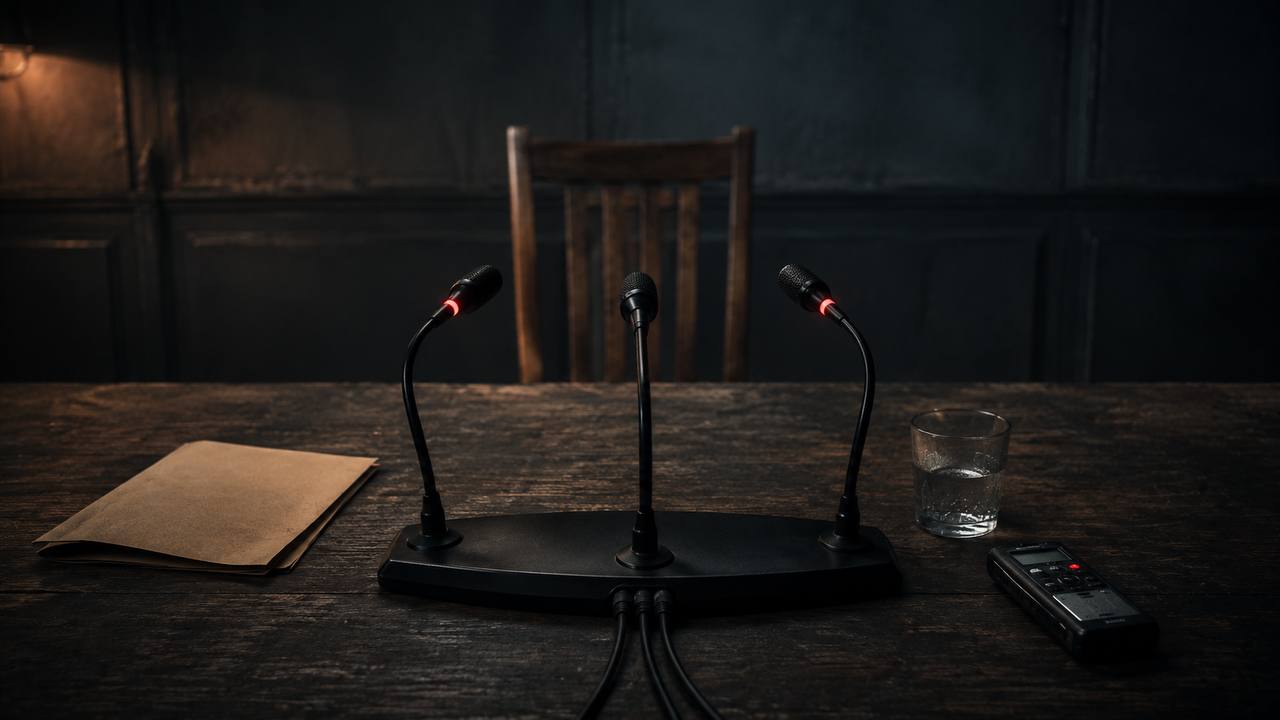
Listening · the press conference, day 42
A 3-minute clip from Dr Reyes' second press conference — the one she gave the morning after the letter arrived. She is asked, on camera, about a conflict of interest. Listen for what she says and what she admits she should have said earlier.
Journalist: Dr Reyes, you released the Marshall data forty-one days ago. Last night something changed in this case. Can you confirm what?
Reyes: I can. Theodore Marshall is my father. I have not lived with him since I was three. I changed my surname when I was twenty-two. I should have told this room on day one. I didn't.
Journalist: Why didn't you?
Reyes: Because I was afraid the science would be dismissed as a daughter's grief project. I now believe I was wrong about that — and that the delay caused harm. I'm sorry for that delay, particularly to the patient himself.
Journalist: Some will say the data should be reviewed by a lab with no family tie. Will you accept that?
Reyes: I have already asked Goldberg's group at McGill to re-analyse every blink in the record. They have the raw files as of this morning. If they confirm what we have, the discovery stands; if they don't, we retract.
Journalist: Has your father — has Theo — spoken about you, in his blinks?
Reyes: He blinked one word at me, two nights ago. Just one. I won't repeat it in this room. It was a private letter, and it's the only one he could send.
Journalist: Last question — what should we have understood about this case from the start, that we didn't?
Reyes: That patients like Theo could have been heard a decade ago, if we had asked. Never had any of us imagined how much had been said in those rooms — only that no one was writing it down.
Q · Multiple choice
1
What does Dr Reyes confirm at the start of the press conference?
2
She says she chose not to tell the press earlier because —
3
What has she done in response to the conflict-of-interest concern?
4
When asked what Theo had blinked to her, she —
5
Her closing answer implies that —
6
Which grammar feature does her last sentence open with?
Keys · Listening MCQ
1 — b · 2 — c · 3 — a · 4 — c · 5 — b · 6 — a (emphatic inversion).
L3 → L4 echo
Recap from L3: the letter Theo opened tonight is the one you wrote at the end of Lesson 3 — Naomi's draft to her team after she confirmed the signal. The press conference you are listening to is what happens forty-one days later, on tape, when she finally tells the room what the letter had set in motion.
05
Sentence completion · the Marshall case in the press
A long-read summarised in six paragraphs. Complete each sentence with ONE WORD from the article. B2 reading-for-detail — a different format from Lesson 3.
P1. On the night of 23 April an envelope was hand-delivered to a hospital room in Boston. The patient inside could not open it. By morning, his physician — who happened to be his estranged daughter — had read it to him three times. None of the three readings was for the public record.
P2. Dr Reyes had not told the journals, the press, or her co-authors that she was related to her own subject. For forty-one days she had operated in what she would later describe, on camera, as "one of the longest silences of my professional life". The silence ended the morning of day 42.
P3. Clinical history is full of patients who could have been heard a decade earlier. Hospitals across three states have begun retrospective audits of EEG traces logged but never read; preliminary reports suggest at least eleven patients may have been intermittently conscious.
P4. To answer the conflict-of-interest question, Dr Reyes voluntarily transferred the entire raw signal record — every time-stamped blink — to the Goldberg laboratory at McGill. McGill is expected to publish a confirmation, or a retraction, by autumn.
P5. Asked, on day 42, what her father had blinked at her the night the letter arrived, Dr Reyes refused. "It was a private letter," she said, "and it's the only one he could send."
P6. For three years she had been recorded in clinical notes as "attending physician." For one night she became, also, the person the message was for. Neuroethics now has a working term for it: the shift from witness to recipient inside the same consulting room.
1
The letter was delivered by hand on the night of 23 .
2
The physician reading the letter to the patient was, in fact, his .
3
Dr Reyes' silence about the family link lasted forty- days.
4
Hospitals in states have started to audit their old EEG records.
5
The independent laboratory analysing the raw signal record is based at .
6
Dr Reyes refused to say what her father had at her on the night of the letter.
7
For three years, clinical notes had recorded Dr Reyes as an "attending ".
Keys
1. April · 2. daughter · 3. one · 4. three · 5. McGill · 6. blinked · 7. physician
06
Speaking — pick the format
British Council IELTS format. 1 minute prep · 1–2 minute monologue · 1 minute follow-up.
Describe a letter, message or news that arrived later than it should have
You should say:
what the letter / message / news was, and who it came from
how late it was — and why it had been delayed
what would have been different if it had arrived on time
and explain what you took from receiving it when you did.
0:00
Model phrases (B2+ pivots)
Real all-Russian olympiad oral format (regional / final stage). 3 min prep · 2 min monologue · 2 min dialogue with the teacher.
Topic — defend your position
A relative who has waited too long to tell the truth has lost the right to tell it at all.
Your monologue must contain:
a clear position (agree / disagree / partly)
two reasons with one concrete example each
one objection you anticipate, and your response to it
a closing sentence connecting back to today's reading or listening
0:00
Model phrases — high-control argumentation
06+
Speech tracker · check your pace
Right after your monologue (Section 06), press the mic and re-deliver it. The tracker counts your words and gives WPM with a verdict against B2+ targets.
Task · 2-min olympiad re-take
Topic."Was Dr Reyes' 41-day silence a professional failure — or a private right she was allowed to keep?"
10-second plan. Take a position → give two reasons → add one example (Naomi and Theo, from Sections 03–05) → close with an inversion ("Not until day 42 did she…").
Then press the mic below and speak for two minutes without breaks. Aim for 120–160 WPM, and use linkers instead of "erm" (which is why · in fact · that said).
At least two takes. The goal isn't a perfect delivery — it's a cleaner one than your last.
SPEAK
🎙 Mission · Three questions, your voice on record
Goal: 60–90 seconds per answer · target 130–160 words per minute · use the vocab cards from this lesson. Click 🔊 Listen to hear the question, then 🎙 Record and speak. WPM and transcript appear automatically.
Q1
For forty-one days Dr Reyes withheld the fact that the patient she had made famous was her own father. Has she, in your view, lost the right to be heard as a scientist, kept that right by going public on day 42, or did she never lose it at all?
Speak now (60–90 s): your verdict · one reason that defends it · the strongest objection from the other camp · one condition under which you would reverse your judgement.
— ready —
Q2
There is a person you have not spoken to in many years. You are given one message you can send — six letters long, no more. To whom would you send it, what would the six letters be, and what are you choosing not to say in the letters you keep?
Speak now (60–90 s): the addressee · the six letters and why those · what you are deliberately omitting · what you fear they will read into it.
— ready —
Q3
Theo blinked the word FATHER at Naomi instead of any data she could publish. If Naomi were your closest friend, what would you say to her at breakfast the next morning — about her work, about her father, and about the version of the story she is now allowed to keep private?
Speak now (60–90 s): what you say about the work · what you say about the father · what you advise her to keep private · the sentence you do not say out loud.
— ready —
CHALLENGE A · Devil's advocate
Take the opposite position to your own answer in Q1 — and defend it as if you believed it. Sixty seconds.
Reported-speech gate: use at least three reporting verbs — argued · insisted · admitted · maintained · conceded · denied — to attribute claims to the other camp.
Speak now (60 s): opposite stance · two reasons for it · attribute one reason to «Reyes' supporters» and one to «her critics» in reported speech · close with «In fact, …».
— ready —
CHALLENGE B · The press conference
You are Theo Marshall. Blink-by-blink, your full reply to Naomi takes ninety seconds — but in your head, it is whole. Record it as you would say it if your voice came back tonight. Ninety seconds.
Grammar gate (at least one of each): reported speech («I had told you, in March of 1995, that…»), perfect modal («I should have come back when…»), emphatic inversion («Never had I…»).
Speak now (90 s) — four beats: what he had been trying to say since March · what he should have done in 1995 · what he wants her to keep doing as a scientist · the one sentence he wants her to remember.
— ready —
Q1 — The right to be heard, after forty-one days of silence.
My short answer is: she kept the right by going public on day 42 — but only because she went without being forced. The reason I defend that is procedural: science doesn't ask whether a result was discovered with clean hands, it asks whether the data survives independent re-analysis. She has already sent every blink to McGill; if Goldberg's group confirms the signal, her silence about the family link is a serious ethics issue, but it doesn't unbuild what the patient was telling her. The strongest objection from the other side is that a forty-one-day silence about a daughter–father tie is itself data — that her interpretation of his blinks might have been generous. The condition under which I would reverse my view is precisely that: if any of the eleven decoded weeks turns out to be over-reading, she goes.
Q2 — Six letters to someone you have not spoken to.
I would send them to my grandmother, who has been dead nine years. The six letters would be «I HEARD.» Two words, one of them only one letter. I am deliberately not writing what I heard — because writing it down would let me edit it, and what I want her to know is that the version of her she left me, the raw one, is the one that stayed. What I fear she would read into it is that I am thanking her too late. What I want her to read into it is that there is no such thing as too late when the listening was done in time.
Q3 — Breakfast with Naomi the morning after FATHER.
About her work, I would say: publish the science exactly as you would have published it before yesterday — keep the lab's hands clean of the family story, so the family story doesn't pollute the data. About her father, I would say: he has been answering you for three years; the fact that you only just heard the word doesn't mean he started saying it last night. The part I would tell her to keep private is the six letters themselves — those are not for the press, they are for her. The sentence I would not say out loud, because she already knows it: he forgave you before you forgave him.
CHALLENGE A — Devil's advocate (opposite to Q1).
Suppose I argued the opposite — that Reyes has lost the right to be heard as a scientist regardless of day-42 disclosure. Her critics have insisted that any interpretation of an EEG by a relative is no longer interpretation, but advocacy. They have maintained, with some force, that she had ample weeks to declare and didn't, and that scientists who control disclosure also control narrative. Her supporters have conceded that the delay was wrong while arguing the science still stands on its own. The honest middle is that the science is intact but the storytelling is compromised. In fact, what she has lost is not the right to be heard, but the right to be the only voice in the room.
CHALLENGE B — Theo's ninety seconds.
Naomi. I had been telling you, since March of nineteen ninety-five, that I should have come back. The week your mother put my watch in your drawer was the week I started to. I lost the bus, and then I lost the year, and then I lost the door — and after that there was nothing to come back to that you would still answer. I should have written. I should have phoned. I should have shown up at school. Instead I read about you for fifteen years, in journals, and I was proud, and I was a coward, and the two are not the same word but I made them the same answer. Never had I imagined I would talk to you only after I lost my voice. Keep doing the work. Stop reading my drafts. Theo, on the record, says: you were always the patient I came back for.
💡 B2+ pace target: 130–160 wpm. Below 100 is too slow. Above 180 you start dropping endings. The transcript under each answer is what the mic actually caught — if it shows "…" instead of a word, that's exactly where your delivery blurred.
07
Use of English · turning the press conference into prose
McGill has asked Naomi for a written statement they can publish alongside their independent re-analysis. She has to convert spoken Q&A into a journal-style paragraph — reported speech, perfect modals, one controlled inversion. Help her finish the proof.
7.1 · Cloze · the reported paragraph
In the press conference of 4 May, Dr Reyes confirmed that the patient in her care (__1__) her father. Asked why the relationship (__2__) declared earlier, she admitted she had been afraid the science (__3__) be dismissed as a daughter's grief project. She said she now believed she (__4__) wrong about that. The McGill group, she added, (__5__) re-analyse every blink in the record before any further claim is made public.
1
2
3
4
5
7.2 · Open cloze · perfect modals · what could / should / must have happened
Type one word per gap. Each gap is a modal: should · could · might · must · would.
1
Dr Reyes said she have told the room on day one.
2
If anyone had asked the right question earlier, the signal have been caught eleven weeks ago.
3
Theo have been signalling deliberately for weeks before anyone noticed.
4
Had her co-authors known of the family link, they have insisted on independent review at the start.
5
Without the McGill audit, the result never have stood the test of peer review.
7.3 · Inversion · the sentence the medical schools are teaching
Re-order each prompt into a single sentence beginning with the negative or restrictive phrase. Drag the words by speaking them aloud — write the answer in the box.
1
Prompt: «None of us had imagined the silence could be conversation.» → Never had that the silence could be conversation.
2
Prompt: «The signal had not appeared until late March.» → Not until late March at all.
3
Prompt: «The team only realised the pattern was intentional after the third week.» → Only after the third week that the pattern was intentional.
Keys · Use of English (7.1 + 7.2 + 7.3)
7.1 · Cloze: 1 — was · 2 — had not been · 3 — would · 4 — had been · 5 — would.
7.2 · Perfect modals: 1 — should · 2 — could · 3 — must · 4 — might · 5 — would.
7.3 · Inversion: 1 — any of us imagined · 2 — did the signal appear · 3 — did the team realise.
L1 → L4 echo · resolved
The phrase «wound the wrong way for a very long time» — the line from the watchmaker's logbook in L1 — was Theo's line, written for himself, decades before the stroke. The brass clock above his hospital bed is the same one that hung in the workshop in 1995. He had been winding it, in his head, the whole time. The moment of truth was always going to be a daughter and a sentence she did not need anyone to translate. FATHER.
08
Word Formation · the letter and the family
Use the word in CAPITALS at the end of each line to form a word that fits the gap. Olympiad format (EGE / MCK).
1
The letter contained Theo's first in three years (ADMIT).
2
Naomi made an emotional at the press conference (APOLOGIZE).
3
The case raised serious ethical for hospitals worldwide (CONSIDER).
4
Her decision to come public was widely at first, supported later (CRITIC).
5
Theo's silence had been deeply to his family, not empty (MEAN).
6
Both father and daughter sought that night (FORGIVE).
7
The clock had been a silent of his mother all along (REMIND).
Rewrite each sentence so it keeps the same meaning, using 2 – 5 words including the key word in CAPITALS. Focus: reported speech · perfect modals · emphatic inversion.
1
«I am his daughter,» Naomi said. TOLD: Naomi his daughter.
2
Naomi did not tell anyone until day 42. UNTIL: Not until day 42 anyone.
3
The team could have caught the signal earlier. SOONER: The team the signal sooner.
4
She had never imagined his blinks were words. NEVER: Never that his blinks were words.
5
It is a pity she did not speak sooner. IF ONLY: If only sooner.
6
«I forgave you years ago,» Theo blinked. SAID: Theo blinked, years before.
Keys
1. told the room she was · 2. did Naomi tell · 3. could have caught · 4. had she imagined · 5. she had spoken · 6. saying he had forgiven her
10
Phrasal verbs · the language of confession
Six phrasal verbs that show up when people tell hard truths. Fill the gap with one — adjust the tense if needed.
Bank: give away · open up · hold back · put off · get over · own up to
1
Naomi could not the press conference any longer.
2
She had been the family connection for forty-one days.
3
In her opening statement she finally about her father.
4
She refused to what Theo had blinked at her — that letter was private.
5
Asked about the delay, she her mistake without excuses.
6
It will take her years, she said, to what happened that night.
Keys
1. put off · 2. holding back · 3. opened up · 4. give away · 5. owned up to · 6. get over
11
Key-transformation · rewrite the finale
Rewrite each sentence so it means the same, using 2 – 6 words, including the key word in CAPITALS. Grammar targets of the finale: reported speech · perfect modals · emphatic inversion.
1
Theo had never blinked a whole word before now. NEVER: Never before a whole word.
2
It was a mistake for Dr Reyes not to speak sooner. SHOULD: Dr Reyes sooner.
3
Naomi realised he could hear her at that exact moment, and not before. ONLY: Only then that he could hear her.
4
"I forgave you years ago," Theo blinked to Naomi. TOLD: Theo years before.
5
Theo can't speak. If he could, he would apologise. ABLE: Were he .
Keys (one acceptable variant each — others also work)
1. had Theo blinked
2. should have spoken
3. did Naomi realise
4. told Naomi (that) he had forgiven her
5. Were he able to speak, he would apologise. (also: If he could speak, he would apologise — 2nd conditional variant.)
12
Open cloze · the press-conference paragraph
Read the paragraph. Type one word (or two) in each gap from the bank below — every word is used exactly once. B2 mixed grammar: reported speech · perfect modals · inversion · 2nd conditional · prepositions · linkers. EGE Use-of-English style.
Word bank · use each once
have · more · had · had known · to say · were · would do · at · has · or
1 "I should told you sooner," Dr Reyes said on day 42. "For 2 than a month I have been telling myself I would find the right moment." Never 3 she imagined that the person the world was writing about was her own father.
Naomi 4 about the family link since day one, but she chose 5 nothing. When asked whether she regretted the silence, she replied that if she 6 in the same room again, she 7 the same thing.
The independent laboratory 8 McGill is expected to confirm the results by autumn. Not one senior colleague 9 criticised her openly. She will publish the confirmation, 10 retraction, under her own name.
Keys · grammar targets
1. have (perfect modal) · 2. more (comparative) · 3. had (inversion, past perfect) · 4. had known (past perfect) · 5. to say (infinitive after chose) · 6. were (2nd conditional, subjunctive) · 7. would do (2nd conditional main clause) · 8. at (preposition, institution) · 9. has (present perfect after negative-inversion) · 10. or (linker between two possible outcomes).
12+
Bonus write · Theo's reply, blink by blink
Optional. Tonight, after the press conference, Naomi sits in chair 2 again. She asks one question and waits. Write Theo's reply — 120–150 words, including at least one reported-speech construction, one perfect modal, and one inversion.
📚 Homework · olympiad practice (optional) tap to open
Three short olympiad-style tasks around the finale — press, family, silence. Do at home in any order. Not required, but the ending settles when you try at least one.
A · Word formation (5 items)
Read the sentence. Use the word in CAPITALS to form a word that fits the gap.
1. Dr Reyes' first ______ at the press conference set the tone for what followed (STATE).
2. The family link had been kept in complete ______ for forty-one days (SILENT).
3. Naomi accepted full ______ for the delay in going public (RESPONSIBLE).
4. The McGill audit was announced as an act of ______ (TRANSPARENT).
5. The room fell into an ______ hush the moment Theo blinked FATHER (COMFORT).
B · Mini cloze · a letter arrives late (5 gaps, 4 options each)
Choose A, B, C or D for each gap.
Letters that arrive late do more damage than letters that never arrive at (1). The reader knows, now, that the answer was sitting somewhere for years — folded, waiting, honest — and no one (2) to open the envelope. In some families this counts (3) a small crime. In others it counts as ordinary weather. Naomi's letter, whatever it contained, (4) the daughter more than it addressed the scientist. And the scientist, in return, chose to keep the exact wording (5) herself.
1
2
3
4
5
C · Reading T / F / NG · «The night the letter arrived»
Re-open the reading in Section 03. For each statement, choose True, False, or Not Given. Same close-reading skill as the regional round.
1
The envelope was addressed in Dr Reyes' own handwriting.
2
Theo's estranged daughter read the letter aloud three times before dawn.
3
The night nurse remained in the room throughout the reading.
4
The brass clock on the wall had once belonged to Naomi's mother.
5
Naomi's boss at the lab had already been told about the family connection.
6
Theo blinked the word FATHER before Naomi finished reading the letter for the third time.
Reading T/F/NG answers: 1-F (the envelope was in Theo's own handwriting, not hers), 2-T (three readings before morning), 3-NG (nothing is said about the nurse staying), 4-T (the brass clock is the mother's), 5-NG (the boss's knowledge is not stated), 6-T (FATHER comes before the third reading finishes).
D · Bring back to the encore lesson
1. Re-record your olympiad monologue from Section 6 (or your Challenge B from the speak-mission) once at home. Aim for 130–150 WPM (the speech tracker tells you). Drop it into the cabinet.
2. Finish Theo's reply (Section 12+) — meet the grammar gate (reported speech · perfect modal · inversion). Paste into the cabinet.
3. Pick three vocab cards from Section 2 and write one sentence each that uses both a perfect modal and the card (e.g. «I should have withheld nothing.»). Bring them to the encore lesson.
Episode 4 of 4 · series closing
Four lessons, one sentence: The watch was wound. The signal was received. The mind was still here. The letter was answered. The Voyager series began with a logbook in 1962 and ends with a blink in 2026 — and every artefact in between has been the same artefact: a piece of timing that turned out, in retrospect, to be a person asking to be read.
Encore lessons open in summer 2026. Bring chair 2.
📒 Today's lexicon · 0tap to open
Hover dashed underlines or tap vocab cards — they collect here.